
A recently declassified Joint Chiefs of Staff report on “Berlin Contingency Planning,” produced in June 1961 as the Berlin Crisis was heating up, includes horrific estimates of fatalities and destruction that the execution of U.S. war plans would cause to the Soviet Union and putative allies. According to the JCS, if the full U.S. nuclear force assigned to the Single Integrated Operational Plan (SIOP) struck the Soviet Union, 54 percent of the total population would be killed, that is some 108 million of a total population of 217 million. If the smaller alert force (bombers on 15 minute to 2 hour alert) was used, total Soviet casualties would be 37 percent or about 80 million. Against China, the full force would kill a smaller proportion because there were fewer cities: 16 percent of an estimated 650 million or about 104 million.[1] Poland, the site of Soviet air defense installations, would suffer 2,636,000 million casualties in an attack by the full force. The report, sent to Secretary of Defense Robert McNamara, was for National Security Adviser McGeorge Bundy to use for answering questions posed by White House adviser and former Secretary of State Dean Acheson.[2]
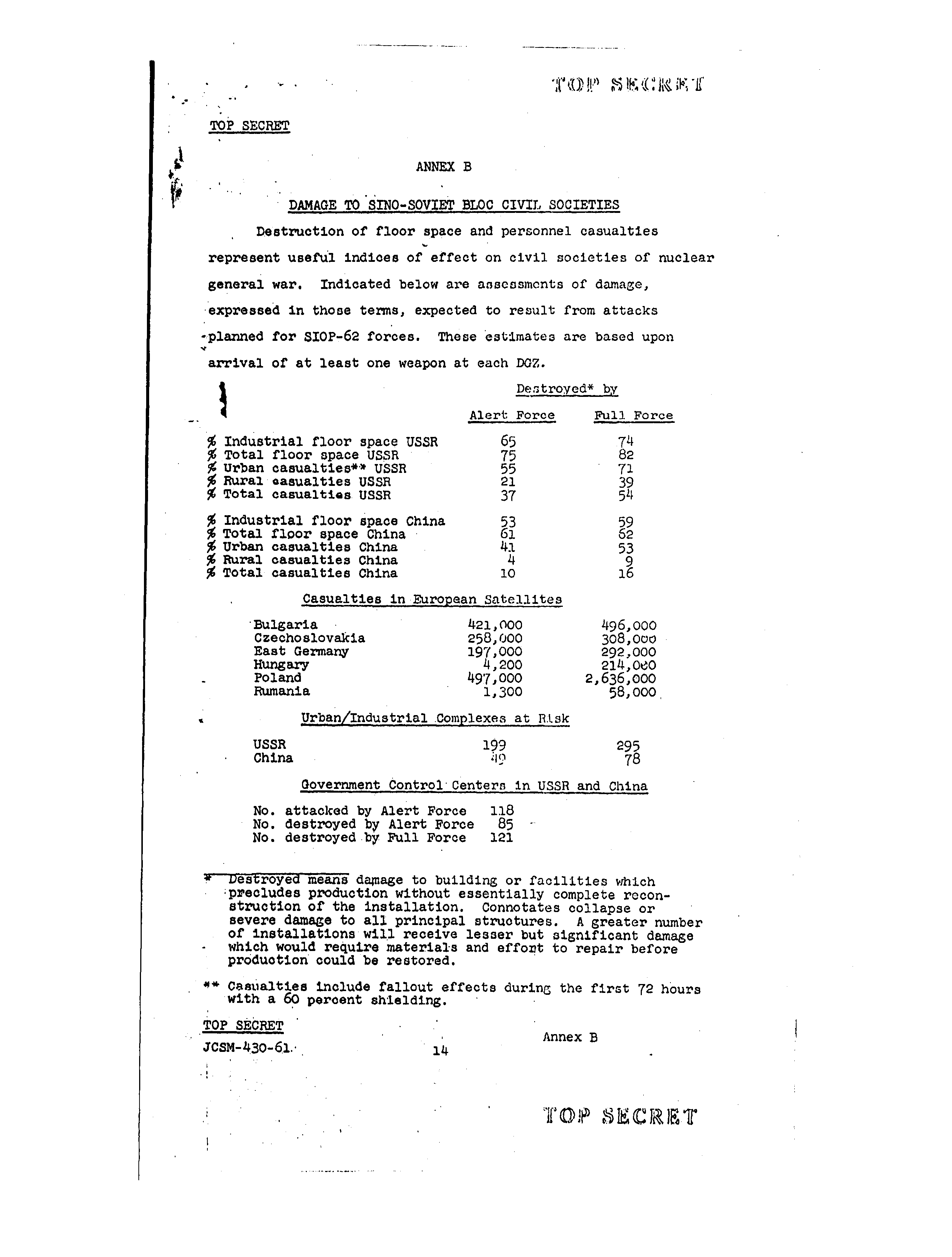
The estimated fatalities would be caused by the implementation of the first SIOP (for fiscal year 1962), which the Defense Department had created to consolidate Air Force, Navy, and Army nuclear war plans and to eliminate duplicate targets, among other problems. The terrible casualty figures were the direct consequence of standard operating procedures used by war planners. According to the JCS report, the SIOP-62 stipulated a 95 percent assurance factor for the destruction of targets “representing a direct threat” to the continental U.S. A very high assurance of destruction in Russia was considered to be essential to minimize the danger posed by Soviet forces to the continental United States. To meet the assurance criteria SIOP-62 posited a mass attack of an alert force of over 1700 nuclear weapons. Some Designated Ground Zeroes (DGZs) would be struck by 2 or more weapons, creating more devastating weapons effects (fires, blast, and radiation). The high degree of assurance is one of the bases of the “overkill” that was associated with U.S. nuclear war plans.[3] (more…)


