
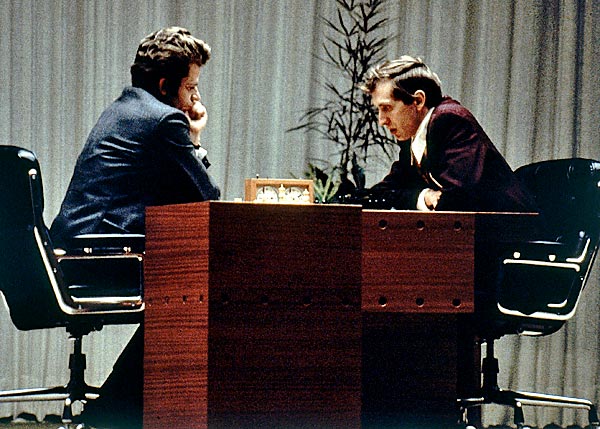
As of the late 1960’s, the Soviet Union had easily dominated international chess during the Cold War. American and Western-European players had never come close to challenging the top four or five Russian grandmasters.
However, this changed with the 1972 chess championship showdown between American Bobby Fischer and Russian Boris Spassky, which garnered worldwide attention and even resulted in the postponement of the 1972 Democratic Convention. To the great excitement of the West, Fischer precociously crushed Spassky. After being defeated in game one, he forfeited the second game (neglecting to show up), and then lost just one more game over the duration of the series, which spanned 21 games total (of a possible 24).
In White King and Red Queen: How the Cold War was Fought on the Chessboard (2008), Daniel Johnson devotes a few pages of speculation to the spy games played by the KGB at the Spassky-Fischer match, which was held in Reykjavik. There is no question that there were numerous KGB operatives present at the match, and it is likely that one of them even managed to bug the chair used by Fischer (discovered when the chair was X-rayed at Fischer’s demand). However, many of the details remain unsubstantiated. Johnson speculates that CIA involvement was minimal, though Secretary of State Henry Kissinger – aware of the potential significance of a Fischer victory – did phone Fischer for encouragement near the beginning of the series.
Now, Frank Brady – author, chess expert and friend of Fischer – has published a new account of Fischer’s life entitled Endgame. From an interview publicizing the book, it appears that Brady’s research has yielded further information about the spygames surrounding the Fischer-Spassky match. Apparently, the Soviets maintained a “secret” laboratory in which psychologists and chess grandmasters worked in tandem to study Fischer.
Indeed, it’s an interesting launching point for FOIA requests targeting the (possible) intelligence activities of both sides during the 1972 series.

 UNREDACTED: The National Security Archive Blog
5 responses to “Bobby Fischer, The CIA, and the KGB.”
[…] This post was mentioned on Twitter by NatlSecurityArchive, Áine MacDermot. Áine MacDermot said: Bobby #Fischer, The #CIA, and the #KGB http://bit.ly/fkvFyU #chess #Russia #ColdWar #history #intelligence #Kissinger #Spassky #FOIA […]
Fascinating.
they always are in war good tell mike fascinting
[…] The U.S. government was deeply interested in the Fischer Spassky match and what it represented. Fischer was considered to be an extension of the United States. […]
[…] The U.S. government was deeply interested in the Fischer Spassky match and what it represented. Fischer was considered to be an extension of the United States. […]