

The new Smith Bagley Research Center at the National Security Archive has opened, and we are resuming our Blog about unpublished collections available in its reading room. Today, we feature the “Douglas Valentine Vietnam collection.”
In August 2006, historian Douglas Valentine donated four bankers-sized boxes of materials used to research his book “The Phoenix Program,” published in 1990 by William Morrow and Company, Inc. The book describes the Phoenix / Phung Hoang covert CIA program created to combat the civilian infrastructure that supported the Viet Cong / National Liberation Front (NLF) insurgency in South Vietnam. The collection includes handwritten notes from over 200 interviews and declassified documents obtained through the Freedom of Information Act.
To those unfamiliar with the Phoenix program, which operated in South Vietnam from 1968 to 1972, its tactics against suspected NLF civilian sympathizers and activists in South Vietnam included neutralization by means of detention, kidnapping, murder, and even torture. In the early 1970s serious questions were raised about its methods and U.S. compliance with the Geneva Conventions. A report issued by the U.S. House of Representatives in October 1972 titled “U.S. Assistance Programs in Vietnam” presented contrasting views of the controversial pacification initiative. Ambassador William E. Colby, on leave from the CIA to direct U.S. pacification programs in South Vietnam, strongly defended Phoenix, but when asked “Are you certain that we know a member of the Vietcong Infrastructure from a loyal member of the South Vietnam citizenry?” Colby, who became Director of the CIA from 1973 – 1976, answered, “No. Mr. Congressman, I am not.”
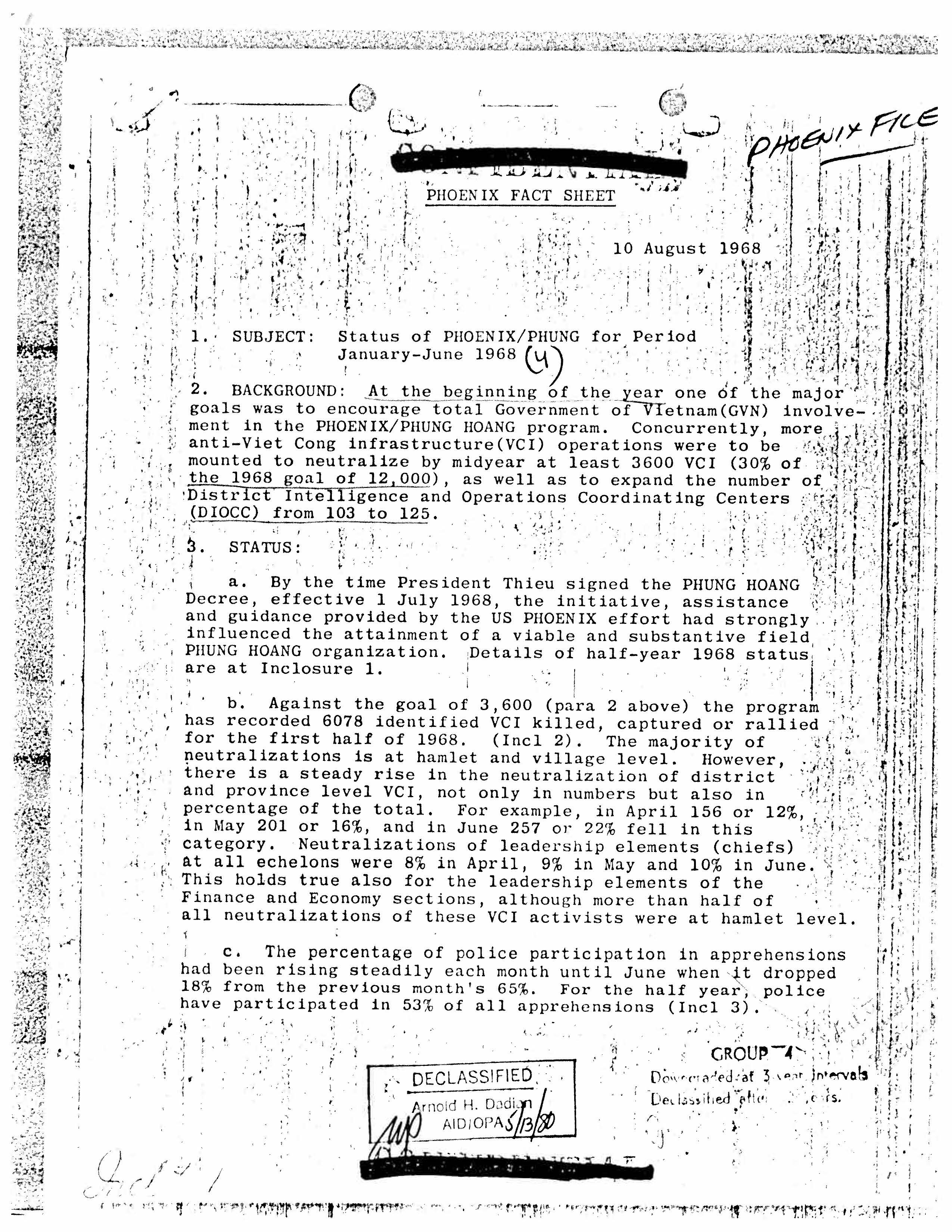
The August 10, 1968 ten-page document that we selected gives a complete overview of the “Phoenix” program after its first half year of operation. It shows clearly that Phoenix was based upon “goals” for the number of enemy to be “neutralized.” It was compiled by the Reports Branch of the central Phoenix Directorate in Saigon, part of CORDS, the overall U.S. pacification organization (Civil Operations and Rural Development Support). The Phoenix Fact Sheet provides a numbers-based impersonal summary of a program that relied on subjective and often uncorroborated evidence against individuals in hamlets and villages.
Researchers interested in viewing this collection should email nsarchiv@gwu.edu .

 UNREDACTED: The National Security Archive Blog
6 responses to “No FOIA Request Needed: The Douglas Valentine Vietnam Collection”
[…] collection joins the “Douglas Valentine Vietnam Collection,” which focuses on the controversial Phoenix Program. Both collections are unique to the […]
my father was heavily involved in Phoenix in the DRAC region or 44th STZ working under John paul Vann and John V Swango. I am looking for any information on his work during his tours. .His name was Major David w Decker, nickname was sometimes Jack or Skip.
[…] of the word “neutralize” is especially chilling here, since it was concurrently used by the CIA’s Phoenix Program in Vietnam (1965-1972). In that operation U.S. special forces “neutralized” suspected Viet Cong […]
[…] legal documents from his lawsuit against the CIA. His papers collected in the writing of the book are held by the National Security Archives, and available to researchers. Many of his taped interviews, […]
[…] legal documents from his lawsuit against the CIA. His papers collected in the writing of the book are held by the National Security Archives, and available to researchers. Many of his taped interviews, […]
[…] program, Valentine managed to penetrate the agency and interview dozens of agency officers. His Phoenix research materials are available to the public at the National Security Archive. His interviews with several CIA […]