
The five cables posted on the El País website on 15 February 2011 include information pertinent to the upcoming presidential elections, to be held in September 2011. In 09GUATEMALA1035, a cable from 24 December 2009, Ambassador McFarland weighed in with his views of the First Lady, Sandra Torres de Colom, who is currently involved in social programs through her Social Cohesion Council. In a meeting with Deputy Assistant Secretary Julissa Reynoso, “Torres de Colom appeared calm, confident and likable….Torres de Colom is hoping to garner rural support when she runs for president in 2011 and these programs are an integral part of establishing herself as an effective leader in [rural] communities.”
Reynoso also met with Otto Pérez Molina of the Patriot Party (PP, Partido Patriota), the leading candidate for the opposition. Pérez Molina stated that his campaign would focus on security issues and justice reform, though it would also include the PP’s own version of Torres de Colom’s “My Family Progresses” program, which provides assistance to poor families if the children stay in school and their vaccines are kept up-to-date. Interestingly, when asked about US-Guatemala relations, Pérez Molina stated that commercial relations are the most important issue, though he recognized that President Obama was more concerned with human rights.
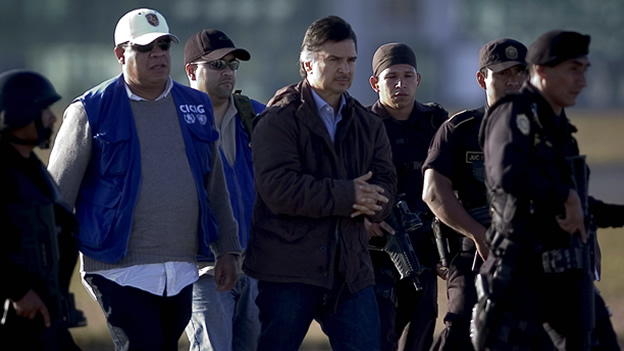
Carlos Castresana, former head of the UN-supported International Commission Against Impunity in Guatemala (CICIG, Comisión Internacional Contra la Impunidad en Guatemala), and McFarland’s discussion of the 26 January 2010 arrest of former President Alfonso Portillo, in 10GUATEMALA27, was also informative. Portillo is currently on trial in Guatemala on charges of embezzlement and wanted in the US for money laundering. Castresana stated that immediately following his arrest, Portillo was given the option of receiving a reduced sentence in Guatemala if he would agree to be extradited to the US, or he could remain in Guatemala at the “dangerous” Zone 18 Prison in Guatemala City while he awaited and stood trial for the charges against him in Guatemala, and while he contested extradition to the US. Portillo chose to remain in Guatemala. In his discussion with McFarland, Castresana stated that he believed an attempt might be made on Portillo’s life if he remained in Guatemala. Castresana suggested that La Cofradía, a group of powerful former high ranking military officers allegedly involved in narcotrafficking and other crimes who had participated in Portillo’s embezzling of millions of dollars, might try to prevent him from cooperating with US authorities. The Embassy also recognized that La Cofradía might take action against high-profile figures or staff of the CICIG, who are co-plaintiffs on the embezzlement case, to send a message and protect their position. For the Ambassador, however, Portillo’s arrest also sent a clear message. He commented in the cable that “Portillo’s capture is a major victory for CICIG, the USG, the Attorney General’s Office, and for the rule of law in general. It is a powerful message that no one is above the law, even ex-presidents, and that actions have consequences. It also punctures the myth that the powerful can always escape justice.” (more…)


