

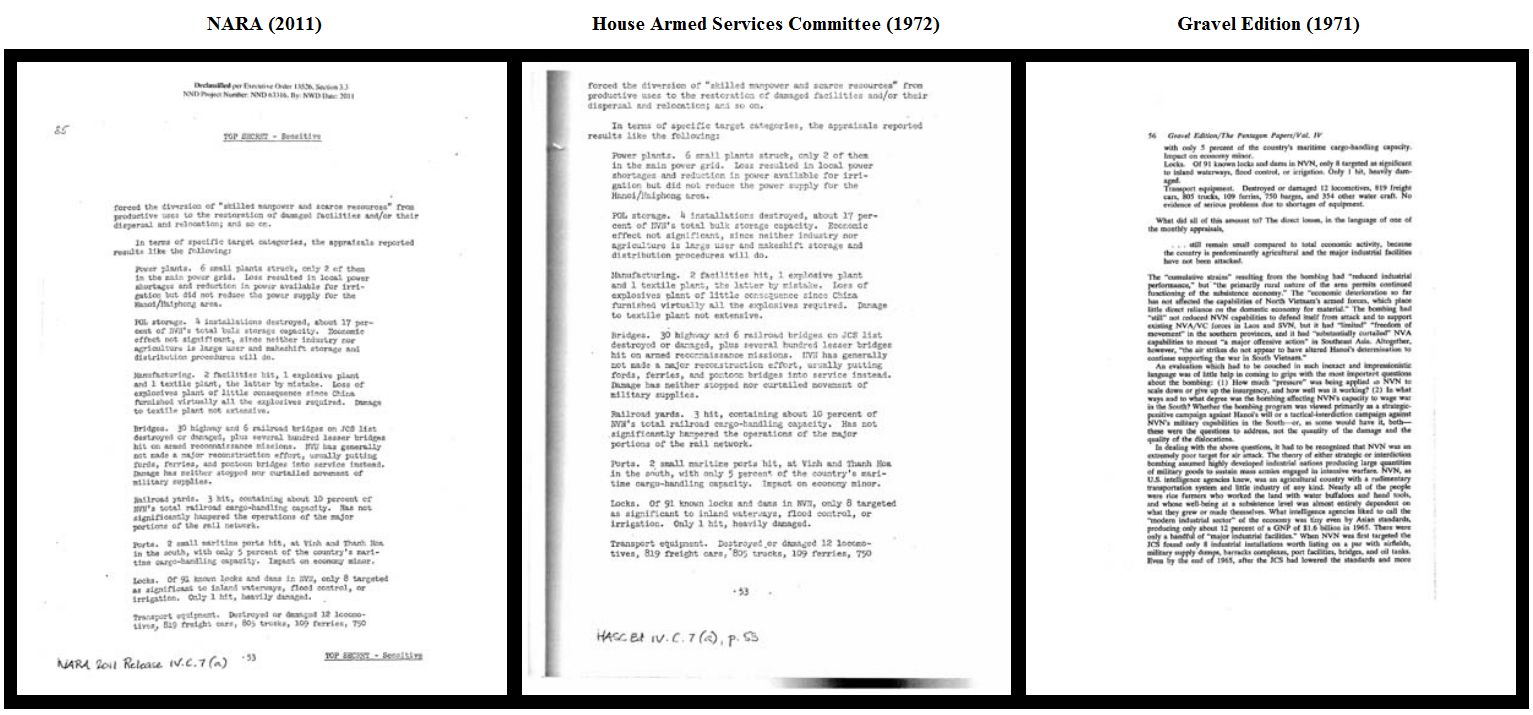
9/16/2011 Update: For the first time ever, all three major editions of the Pentagon Papers are being made available simultaneously online. You can view this unique side-by-side comparison at the National Security Archive website. This comparison shows readers exactly what the U.S. government tried to hide for 40 years by means of deletions from the original text.
Be sure to check out the Archive’s special contest to nominate the infamous “11 words” that some officials tried to keep secret even this year! Details can be found here.
———————
The Pentagon Papers have been available to the public for 40 years. Despite this, the federal government recently spent substantial human and monetary capital reviewing and re-reviewing every page, line, and word, of the Pentagon Papers, which Daniel Ellsberg originally leaked in 1971.
Earlier this summer, the National Archives announced that it had finally finished its review of the Papers, and that only eleven words needed to remain redacted. At a Public Interest Declassification Board Meeting, the Archivist of the United States, David Ferriero, even joked that historians could “play Mad Libs” with the missing eleven words. (This reference has since been scrubbed from NARA’s blog, but not from Steve Aftergood’s “Secrecy News.”)
In response, I joked at the meeting that I would simply check the already available Gravel edition of the papers and –not wanting to get in trouble– fill in the Mad Lib with the 90-year-old invisible ink recipe the CIA had just declassified. My “secrecy humor” got just a tepid response from the crowd.
And I was only partially correct. The eleven words were actually published in the House Armed Services edition of the papers –which had been reviewed and redacted by the DOD in 1972– not the Gravel edition. (See here for an analysis of the different releases of the Papers.) Just before the Paper’s “official” publication, an alert archivist at the Johnson Presidential Library discovered that the eleven-word “needle” in the “haystack” of the Pentagon Papers had actually already been declassified. John Prados of the National Security Archive, another archivist wrote in an email, would quickly find the eleven words and “parade this discovery like a politician on the 4th of July.” It looks like that expansive (and expensive) declassification review was unnecessary, after all.
So what does Prados think the eleven words were? He takes eleven guesses and provides deep analysis on the Archive’s website. Here’s a condensed list:
1. “…the first view was primarily supported by the military and the CIA both in Washington and in Saigon….” (IV. B. 5, p. iv)
2. “‘Initial Report of CAS Group Findings in SVN,’ dated 10 February…” (IV. C. 1, p. 23)
3. “…small-scale RECCE STRIKE Operations in North Vietnam after appropriate provocation.” (IV. C. 1, p. 83)
4. “…covering a two destroyer Patrol Group with on-line Crypto RATT…” (IV.C.3, p. 17)
5. “…it is understood that a Joint State, Defense and CIA committee…” (IV. C. 6 (b), p. 38)
6. “Of 91 known locks and dams in NVN, only 8 targeted…”(IV. C. 7 (a), p. 53)
7. “…obvious bid to turn ROLLING THUNDER into a punitive bombing campaign…” (IV. C. 7 (a), p. 83)
8. “…of ahigh-level defector and concluded with a disturbing estimate…” (IV. C. 7 (b), p. 154)
9. “…Westmoreland obtained his first authority to use U.S. forces for combat…” (IV. C. 9 (a), p. 63)
10. “…Lansdale’s group and the CAS, I am canvassing attitude of sect…” (V. B. 3, p. 812)
11. “…9:30 a.m. today according to a telephone intercept Kosygin called Brezhnev…” (VI.C.3 (1), p. 61-62)
Check Prados’s post for his full analysis of each of these candidates.
Do you have a candidate for the “Eleven Words?” If so, post it here with an explanation. Prizes will be awarded for convincing candidates. (But alas, it won’t be as good as parading around like a politician on the Fourth of July.)


