
By Eamon Eriksen
The next time you request documents for declassification, it is likely your submission will be processed by a private contractor, not a government employee.
The privatization of the FOIA process has proliferated in recent years. According to a recent Bloomberg article, “At least 25 agencies are outsourcing parts of the FOIA process, a 40 percent jump since Obama’s inauguration.” Since 2009, the government has awarded at least 250 FOIA related contracts, and in most cases contractors now outnumber government employees three to one.
Proponents of outsourcing argue that private contractors can speed the FOIA process, reduce backlogs and save taxpayer money. Speeding up FOIA responses should certainly be a priority, but not at the expense of a quality review process and the proper functioning of government accountability.
Levels of involvement vary from agency to agency, but these contractors are now routinely involved in nearly every stage of the process, including submitting recommendations for what to redact, corresponding with requesters, locating records and drafting responses to FOIA requests.
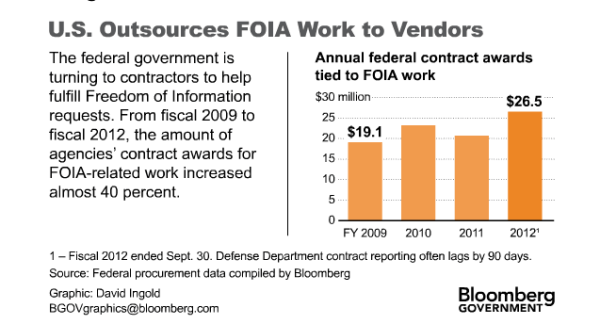
Official policy prohibits private employees from completing tasks that are “inherently governmental,” but whether processing FOIA requests fits this definition is controversial. Officials argue that because government employees continue to make the final decisions, contractors are not infringing on governmental functions. “We do it all for them up until the decision point, and then the government takes over,” explains one contractor. “They’re the decision-makers and we’re the workers” says another.
Disentangling private contractors from “inherently governmental” functions is hardly that simple. “They are walking right up to the line” says said Scott Amey, general counsel at the Washington-based Project on Government Oversight.
Processing FOIA requests requires subjective decisions at every step, decisions that require expertise, discretion, and interpretation best suited to federal employees. By the time a government official reviews a proposed response, often the contractor has already interpreted the request, decided which records are relevant, applied exceptions and redactions, and drafted a response letter. Contract workers are often deeply integrated into the agencies themselves, sharing office spaces, attending the same FOIA training sessions, and receiving the same background checks and security clearances as government officials, thus blurring the line between public and private employees.
Contracting FOIA requests has other drawbacks. For one thing, privatization muddies the chain of accountability. As John Wonderlich, policy director at the Sunlight Foundation, told Bloomberg, “If I was in charge of an agency and wanted to create an unaccountable FOIA process, the first thing I would do is put an outside contractor in charge of it because fewer of our accountability laws apply to them. It would just be another layer between me and the public.”
Privatization also creates potential conflicts of interest for contractors. For example, during the Abu Ghraib torture and abuse scandal, suspicion descended on the contracting firm CACI, which provided translation services at the prison in Iraq. Contractors working for CACI, the second largest recipients of FOIA contracts, could be involved in reviewing documents that pertain to their own company’s transgressions.
Another possible conflict arises when one contracting firm reviews information relating to a competitor’s business practices. It is possible that a FOIA contractor could fail to properly exempt the information, or that the information could be passed back to their employer.
Another concern is the fact that contractors’ educational backgrounds range widely, from high school diplomas to law degrees, and the contractor may lack knowledge about the structure, function and responsibilities of the department for whom they are working.
Officials are correct that FOIA offices are often understaffed, and these positions can be difficult to fill due to the lack of advancement opportunities. But privatization is hardly the only solution to this problem.
The government has taken one step in the right direction. In April of this year, the government established a new occupational series for FOIA and Privacy Act professionals. As one White House official says, this new career track will “elevate the importance of the work performed by” FOIA workers, and according to the Department of Justice’s website, “Maintaining a distinct job category for FOIA professionals will create greater professionalization of the FOIA and Privacy Act workforce which will increase agency efficiency and responsiveness.”
In any case, FOIA offices government-wide should have consistent guidelines for reporting how many contractors they hire, how much money they save in the process, what contractors’ responsibilities are, and what kind of oversight officials exercise.
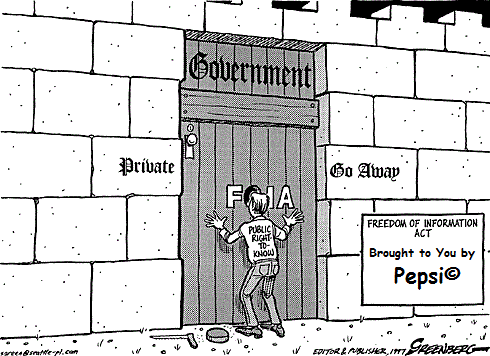
The danger of privatizing the FOIA process is that it could threaten the symbolic purpose the law. The promise of FOIA is to increase transparency and strengthen government accountability. The principle of openness is jeopardized when companies, not the government, in effect decide what information the public can access.


