

Director of National Intelligence General Counsel Robert S. Litt made some huge Sunshine Week FOIA news yesterday when he announced that classifiers and declassifiers must now ask: “not can we classify –but should we?”
Litt announced this change of secrecy policy at the Collaboration on Government Secrecy Freedom of Information Day at American University Washington College of Law. Litt, who spoke from prepared remarks, lambasted Edward Snowden for his disclosures. He also did not appear to give credence to the argument that using the Foreign Intelligence Surveillance Court to secretly create a domestic telephone metadata dragnet program was bad or illegal policy. He did acknowledge, however, that the culture of secrecy cultivated at the NSA and other intelligence agencies could be potentially harmful to the Intelligence Community’s interests.
Update: Here’s the text of his speech. And here’s Steve Aftergood’s take.
Litt’s pledge to continue to declassify technically “properly classified” documents if the harm to national security is outweighed by the public interest is more than just rhetorical window-dressing. If implemented, it would be a serious and beneficial declassification policy change.
(He did not mention issuing a policy directive or memo. Hopefully, he will.)

Currently, if a document is “properly classified” according to a classification guide, declassifiers usually choose to leave it classified –no matter how improper continued classification may be in reality. This applies even to truly “stupid secrets,” such as the Department of Defense’s recent decision to censor the fact that the US removed its nukes from Turkey after the conclusion of the Cuban Missile Crisis.
General Counsel Litt may have wisely realized that this “stupid secrecy” harms the entire US classification regime. If agencies demonstrate that they have so little trust and respect for Americans that they believe the public cannot know how the Cuban Missile Crisis ended, why would Americans trust these same agencies to be the classification gatekeepers of the surveillance establishment?

At the symposium, I applauded Litt for this game-changing step and asked him to confirm that the Intelligence Community would indeed use this “harm versus public interest” test to discretionarily declassify historic documents which were officially “properly classified,” but were irrationally classified in reality. Litt replied in the affirmative and cited the authority granted in Executive Order 13526.
The specific line in the Executive Order that gives the potential power to declassify and release “properly classified information” if the public interest outweighs the potential harm to national security is likely 3.1 (d), which states:
“In some exceptional cases, however, the need to protect such information may be outweighed by the public interest in disclosure of the information, and in these cases the information should be declassified. When such questions arise, they shall be referred to the agency head or the senior agency official. That official will determine, as an exercise of discretion, whether the public interest in disclosure outweighs the damage to the national security that might reasonably be expected from disclosure.”
The 3.1 (d) provision to declassify “properly classified secrets” is rarely used. But if General Counsel Litt is serious about embracing the provision to declassify secrets which are officially “properly classified” but in reality no longer must be hidden (See Steve Aftergood for excellent writing on the problems with classification guides and practice), this could be a gigantic step toward fixing the classification system.
Declassification advocates all too painfully know that if Litt’s proposed standard –rather than a declassification as usual mindset— was embraced by the National Declassification Center, it may not have denied an eye-boggling-high 39 percent of the decades-old historic documents which it reviewed.
Litt also revealed another declassification game-changer during his remarks. He stated that declassifiers will now take into account information in the public domain as they decide if information must truly remain classified. Until now, most declassifiers have rejected considering information in the public domain as they make declassification decisions, relying entirely on their often woefully inadequate classification guides. Litt’s instruction to embrace the facts of the real world when making classification and declassification decision is another welcome Sunshine Week pledge.
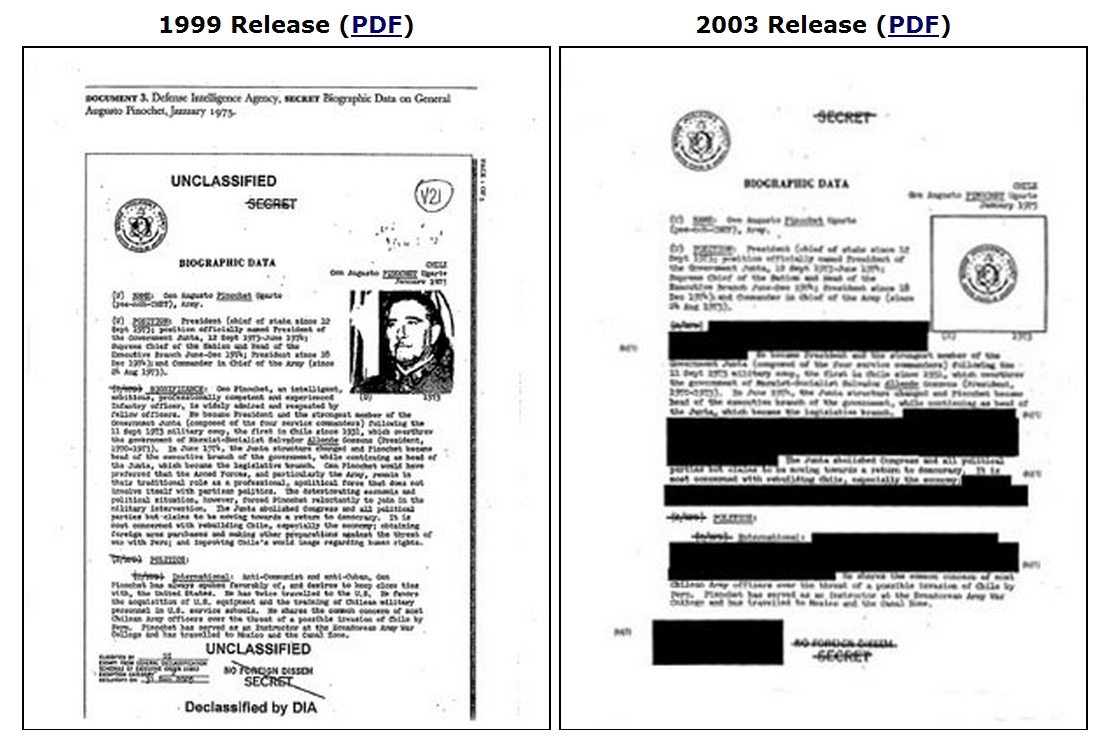
But not everyone was as pleased with Litt’s commitments as I was. One professional declassifier, speaking as an individual, not a government employee, was quick to slam Litt’s proposals. The declassifier claimed that he did not have the authority to declassify documents which were technically “properly classified” –and did not want it. It, apparently, was just fine with him to keep the Jupiters in Turkey, century-old invisible ink recipes, even Pinochet’s fondness of Pisco Sours, hidden from the public as “national security secrets.”
Unfortunately, General Counsel Litt had left the symposium by this point and was not able to respond to these assertions.
Hopefully Litt was earnest in this pledge to begin asking: “not can we classify –but should we?” If this ethos is embraced, it could be the most critical policy fix to date of the overburdened and undemocratic classification regime in America.


