
Senator Feinstein’s quest to declassify her committee’s report on the CIA’s post-9/11 torture program has increased attention on the agency’s illegal –and decades-old– interrogation techniques. Now, newly-declassified portions of the CIA’s infamous 1963 KUBARK manual, a comprehensive guide for teaching interrogators how to effectively create “a world of fear, terror, anxiety, [and] dread,” helps to further contextualize the agency’s long-standing interrogation practices.
The fear of Communist expansion into the Western Hemisphere after Fidel Castro’s 1959 victory in the Cuban Revolution was the geo-political background for the 1963 KUBARK manual. Castro’s victory not only encouraged the 1964 U.S.-supported overthrow of democratically elected Brazilian President Joao Goulart; it also encouraged the CIA to spread KUBARK across the continent to help prop up pro-U.S. governments. After the Brazilian coup, right-wing military leaders across Latin America began seizing control from democratically elected governments with US encouragement, School of the Americas degrees, and a copy of the KUBARK manual.
The Secret, 127-page KUBARK manual, first declassified (with redactions) in 1997 thanks to a Baltimore Sun FOIA request, is a comprehensive guide for training interrogators in obtaining intelligence from “resistant sources.” According to the National Security Archive’s 2004 posting, Prisoner Abuse: Patterns from the Past, KUBARK –a CIA cryptonym for itself– “describes the qualifications of a successful interrogator, and reviews the theory of non-coercive and coercive techniques for breaking a prisoner.”
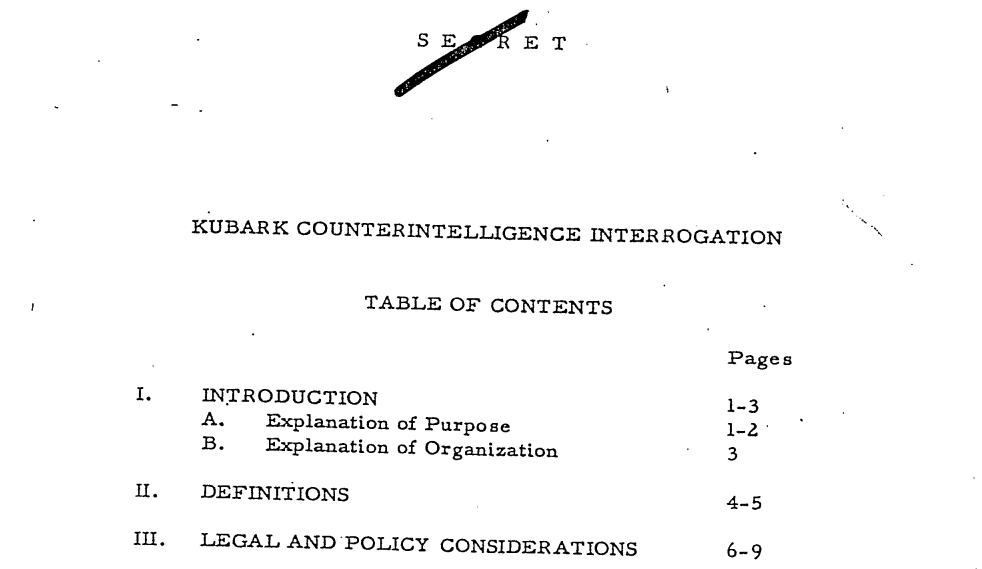
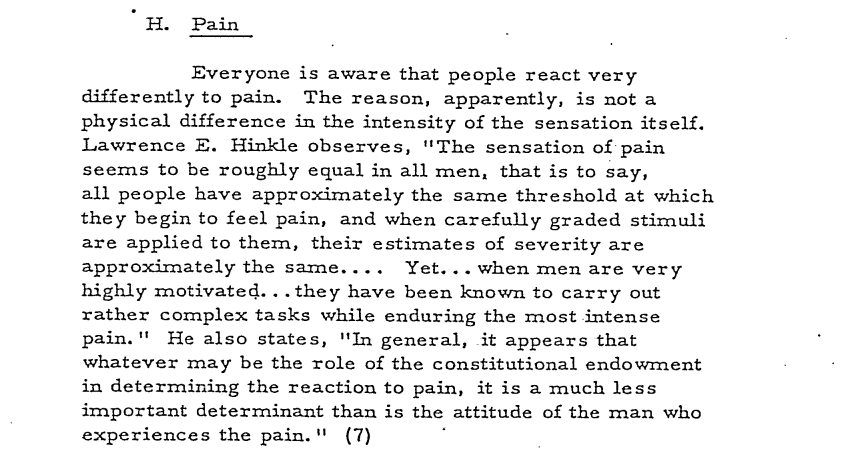
The report contains veiled references to the use of electric shock, saying that when choosing an interrogation site “the electric current should be known in advance, so that transformers and other modifying devices will be on hand if needed.” The manual also notes “the threat of coercion usually weakens or destroys resistance more effectively than coercion itself. The threat to inflict pain, for example, can trigger fears more damaging than the immediate sensation of pain.” Under the subheading “Pain,” the manual’s guidelines discusses theories behind various thresholds of pain, and recommends that a subject’s “resistance is likelier to be sapped by pain which he seems to inflict upon himself” rather than by direct torture. According to Alfred McCoy, author of A Question of Torture, self-inflicted pain, like stress positions, “causes victims to feel responsible for their suffering and thus capitulate more readily to their torturers.”
Now, thanks to a mandatory declassification review request (MDR) filed by MuckRock user Jeffrey Kaye, a less-redacted version of the KUBARK manual is available. Revelations from the new release include the CIA’s admission to doctoring detainees’ interrogations tapes, a practice it considered “effective” in making it seem as though the detainee had confessed, and using foreign intelligence services for detention and interrogation purposes. The references to foreign intelligence services mean that rendition is not a product of the post-9/11 world; it is a practice at least 50 years old. Supporting this, CIA ex-Deputy Counsel John Rizzo said in a recent Democracy Now interview that “[r]enditions were not a product of the post-9/11 era… renditions, in and of themselves, are actually a fairly well-established fact in American and world, actually, intelligence organizations.”
It was only after congressional committees began questioning the CIA’s interrogation techniques in Latin America in the early 1980s, particularly in Honduras, that the agency began to revise its practices, if only temporarily. The result of the congressional attention was an editing –by hand– of the CIA’s “Human Resource Exploitation” manual, based largely off of the earlier KUBARK manual, to alter passages that appeared to advocate coercion and stress techniques to be used on prisoners. CIA officials also attached a new prologue page to the manual stating: “The use of force, mental torture, threats, insults or exposure to inhumane treatment of any kind as an aid to interrogation is prohibited by law, both international and domestic; it is neither authorized nor condoned,” but with the caveat that forms of torture and coercive techniques “always require prior [headquarters] approval” first.

Even though Feinstein’s report does not recommend any further inquiries into the CIA’s interrogation practices, I hope it will generate more resistance to torture than the CIA’s own secret 1985 handwritten changes have.

 UNREDACTED: The National Security Archive Blog
16 responses to “The CIA’s Declassified Torture Handbook: How to Create a “World of Fear, Terror, Anxiety, Dread.””
[…] …read more […]
[…] Unredacted – by Lauren Harper […]
[…] via The CIA’s Declassified Torture Handbook: How to Create a “World of Fear, Terror, Anxiety, Dread.…. […]
You left out the Twitter icon for sharing this page.
[…] https://nsarchive.wordpress.com/2014/04/15/the-cias-declassified-torture-handbook-how-to-create-a-wor… […]
[…] The fear of Communist expansion into the Western Hemisphere after Fidel Castro’s 1959 victory in the Cuban Revolution was the geo-political background for the 1963 KUBARK manual. Castro’s victory not only encouraged the 1964 U.S.-supported overthrow of democratically elected Brazilian President Joao Goulart; it also encouraged the CIA to spread KUBARK across the continent to help prop up pro-U.S. governments. After the Brazilian coup, right-wing military leaders across Latin America began seizing control from democratically elected governments with US encouragement, School of the Americas degrees, and a copy of the KUBARK manual. Continue reading here….. […]
[…] information through FOIA then releasing it to the public. On April 15, 2014, Lauren Harper, wrote The CIA’s Declassified Torture Handbook: How to Create a “World of Fear, Terror, Anxiety, Dread.… which placed the 1963 KUBARK Manual in it historical context. It is an excellent read. Harper […]
[…] fallacious. You'll find all these techniques in KUBARK, which was written for the CIA in the 60s. The CIA’s Declassified Torture Handbook: How to Create a Sign in or Register Now to […]
[…] The fear of Communist expansion into the Western Hemisphere after Fidel Castro’s 1959 victory in the Cuban Revolution was the geo-political background for the 1963 KUBARK manual. Castro’s victory not only encouraged the 1964 U.S.-supported overthrow of democratically elected Brazilian President Joao Goulart; it also encouraged the CIA to spread KUBARK across the continent to help prop up pro-U.S. governments. After the Brazilian coup, right-wing military leaders across Latin America began seizing control from democratically elected governments with U.S. encouragement, School of the Americas degrees, and a copy of the KUBARK manual. […]
[…] CIA’s Declassified Torture Handbook: How to Create a “World of Fear, Terror, Anxiety, Dread” […]
[…] Lauren Harper writes for Unredacted: […]
[…] The cia’s declassified torture handbook: how to create a Description: Senator feinstein’s quest to declassify her committee’s report on the cia’s post-9/11 torture program has increased attention on the agency’s. Post Title : The cia’s declassified torture handbook: how to create a Source : nsarchive.wordpress.com Read More : The cia’s declassified torture handbook: how to create a […]
[…] File Name : The cia’s declassified torture handbook: how to create a Source : nsarchive.wordpress.com Download : The cia’s declassified torture handbook: how to create a […]
Reblogged this on Proletarian Center for Research, Education and Culture.
Philip Agee, a former CIA case officer, blew the whistle on the CIA’s nefarious practices back in the 70’s. His book, “Inside the Company: CIA Diary” is one of the best and most detailed accounts of exactly what the CIA really does to undermine democratic and progressive movements and nations around the world. It is still very relevant.
[…] information through FOIA then releasing it to the public. On April 15, 2014, Lauren Harper, wrote The CIA’s Declassified Torture Handbook: How to Create a “World of Fear, Terror, Anxiety, Dread.… which placed the 1963 KUBARK Manual in its historical context. It is an excellent read. Harper […]