
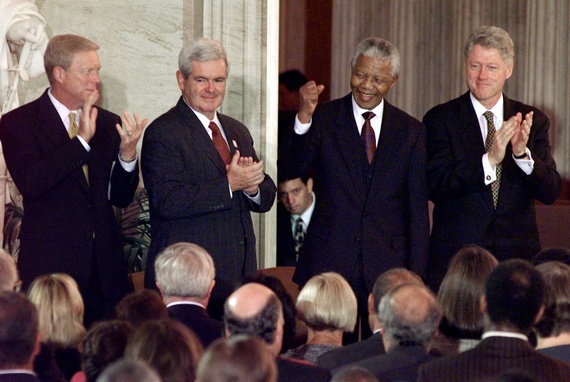
Nelson Mandela was found guilty of sabotage and conspiracy to violently overthrow South Africa’s apartheid government on June 12, 1964, served 27 years in prison, and stayed on the US’ terror watch list until 2008 –including while he was president of South Africa. While the US joined the international community in condemning Mandela’s arrest in 1962, it has long been believed that American intelligence agencies played a key, behind-the-scenes role in the event, and a recent Democracy Now! exclusive with the FBI’s “most prolific” FOIA requester, Ryan Shapiro, adds more to this murky chapter in American history.
US involvement in Mandela’s arrest has been widely suspected after a 1990 Cox News Service report quoted a former U.S. official saying –hours after Mandela’s 1962 arrest– that senior CIA operative, Paul Eckel, told the official, “[w]e have turned Mandela over to the South African security branch. We gave them every detail, what he would be wearing, the time of day, just where he would be. They have picked him up. It is one of our greatest coups.” Despite the report, no US agency has officially admitted to any involvement.
In his interview with Democracy Now’s Amy Goodman, Shapiro discussed his FOIA lawsuit against the NSA, FBI and the Defense Intelligence Agency for their records on any participation in Mandela’s capture. Shapiro, who has a separate case against the CIA for records on Mandela’s arrest, said he filed FOIA requests with the NSA, FBI, and DIA to help determine why the US viewed Mandela as a threat to American security; what role the US intelligence community played in thwarting racial justice in South Africa; and the reasoning for keeping Mandela on the US terror watch list until 2008.
Mind-bogglingly, the NSA glomared (neither confirmed or denied the existence or non-existence of records) Shapiro’s request on the basis that performing a search would compromise both US national security and the Espionage Act of 1917. While discussing the FOIA suit, Shapiro graciously referred to the NSA as a “very difficult nut to crack as far as FOIA is concerned,” further noting that the only times the spy agency “complies with the Freedom of Information Act is when it wants to, which is when the release of records will make the NSA look good.” Which is also not often, it would seem.
In response to Goodman’s question why the Mandela records are so important to him, Shapiro eloquently says, “I want to know why. Nelson Mandela is now almost universally hailed as a tremendous freedom fighter, this heroic figure, and yet the United States actively suppressed his movement, was very likely involved in putting him in prison for decades, and supported both covertly and openly the apartheid state until near its end. Why? And the answer has to do with this blinkered understanding of national security; this myopic understanding that places crass military alliances and corporate profits over human rights and civil liberties. And I’m interested in—I’m interested in highlighting how we as a nation need to foster a broader understanding of national security. And I think by trying to get records on why Nelson Mandela was on the U.S. terror watch list until 2008 is a good opportunity to do that.”
While US involvement in Mandela’s arrest is currently unconfirmed, it is clear that at the time of his arrest U.S. policy towards South Africa was more concerned with preserving access to South Africa’s natural resources than directly confronting apartheid. The Archive will be watching Shapiro’s case very closely in the hopes that judicial review will successfully spur the release of seminal documents on Nelson Mandela’s legacy from these intransigent agencies, and encourage them to more fully uphold their FOIA responsibilities.

 UNREDACTED: The National Security Archive Blog
4 responses to “FOIA Lawsuit Fights to Reveal US Government’s Involvement in Nelson Mandela’s 1962 Arrest”
[…] 7 April 2014 — Unredacted […]
[…] African National Congress, was a designated US’ terrorist organization. Considering that the CIA likely played a role in Mandela’s 1962 arrest, according to Shapiro, “[w]hat’s missing from these documents is […]
[…] FOIA Lawsuit Fights to Reveal US Government’s Involvement in Nelson Mandela’s 1962 Arres… […]
[…] declassified documents obtained by Ryan Shapiro show the FBI monitored Nelson Mandela during the 1990s over a perceived communist threat. The […]