
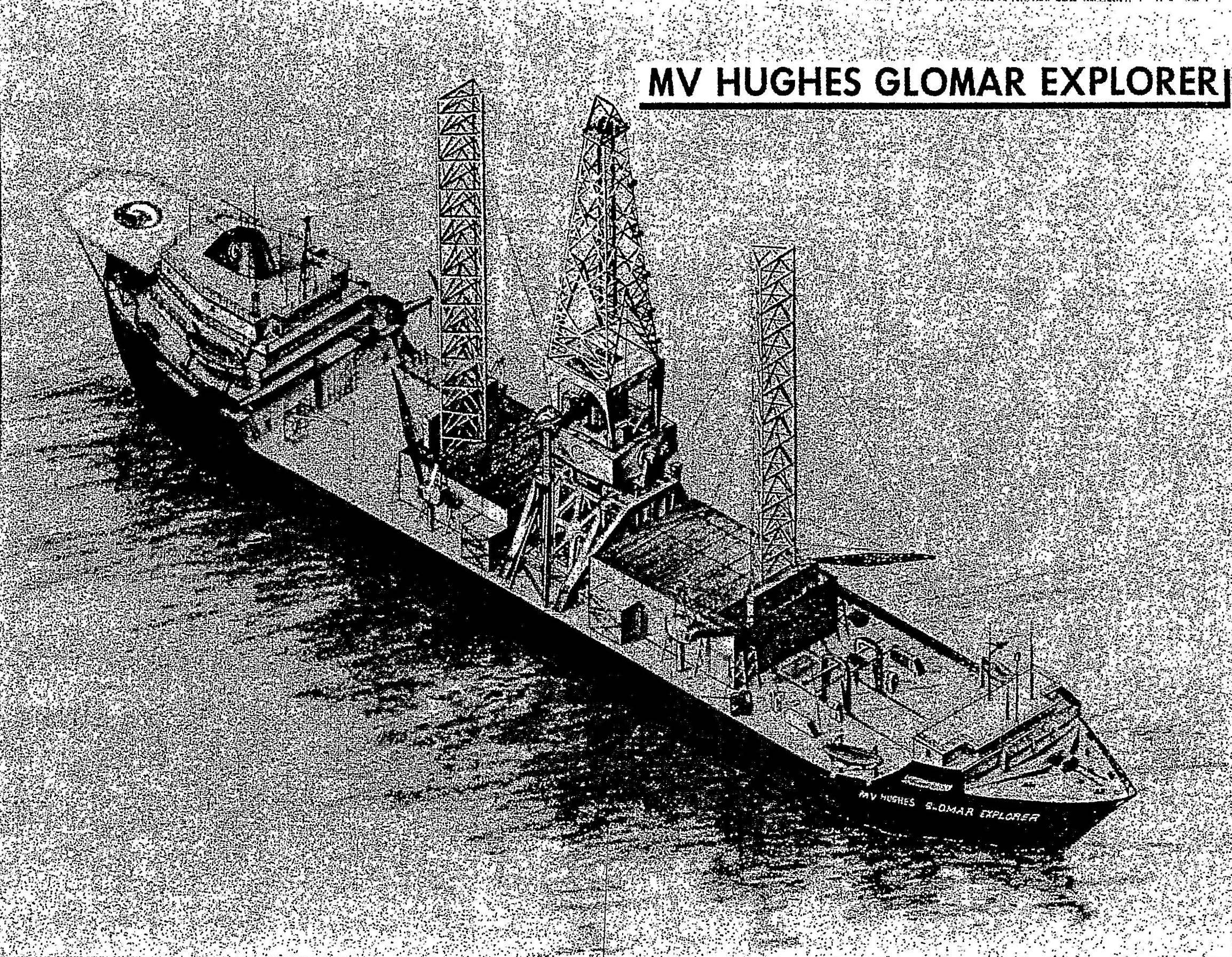
The Central Intelligence Agency’s ability to claim that it can “neither confirm nor deny the existence or nonexistence” of “the use of unmanned aerial vehicles” derives to another vehicle. A boat. An extremely large boat.
The Glomar Explorer, as WNYC’s Radiolab explains, was built by the CIA with help from Howard Hughes for the six year (1968-1974) Project Azorian[1]. Project Azorian was a secret, ambitious endeavor to salvage and examine a Soviet Golf-II class submarine –and its three one-megaton nuclear missiles– which had sunk to the bottom of the ocean floor 1,560 miles northwest of Hawaii. As Project Azorian developed, Seymour Hersh sniffed a story, but the CIA successfully convinced The New York Times to suppress publication. A year later a journalist, Ann Phillippi, filed a Freedom of Information Act request for documents about the Glomar Explorer and the CIA’s attempts to censor press coverage. The CIA, questionably citing FOIA law, claimed it could “neither confirm nor deny” that documents about either the ship or the censorship existed; a judge agreed. The term “Glomar response” stuck. And so did the the ability for the CIA (and the entire US government) to refuse to confirm or deny the existence of documents in response to FOIA requesters.

So how do we know so much today about the Glomar Explorer and Project Azorian? Ironically, because of the Freedom of Information Act. In 2010, my colleagues at the National Security Archive got their hands on a series of declassified table of contents to Studies in Intelligence, the CIA’s classified in-house journal. One of them, the Fall 1985 edition, included the title: “Project Azorian – The Story of the Hughes Glomar Explorer (Secret).” We filed a FOIA request, and eventually received the redacted, but still encompassing and fascinating, internal CIA history of The Glomar Explorer —highly worth a read. Around the same time, my colleague Bill Burr was also able to win the declassification of two memorandums of high-level conversations between President Ford and his national security team as they worried over leaks about the Project. After the National Security Archive posted the CIA’s history of Project Azorian, retired CIA officer David Sharp, who served on the crew of the Glomar Explorer, was finally able to publish his book on the Project, The CIA’s Greatest Covert Operation: Inside the Daring Mission to Recover a Nuclear-armed Soviet Sub. Until the declassification of the Studies in Intelligence article, the CIA’s Publication Review Board had refused to give full approval to Sharp to publish his book.[2]

The CIA’s ultimate declassification of the history of the covert operation that created the Glomar response is certainly symbolic. But it also can be seen as a direct result to a line added by President Obama to his Executive Order on Classification which states, “No information may remain classified indefinitely.”[3]
Sadly, the wisdom that led the CIA to declassify its secret history of the Glomar Explorer has largely not spread to other parts of the Agency –or the rest of the federal government. The use of Glomar non-denial denials also remains rampant;[4] just this week, two more headscratchers have occurred.
- First, the National Security Agency sent two FOIA response letters to Freedom of the Press Foundation reporter (and “FOIA Terrorist“) Jason Leopold. The first refused to confirm or deny the existence of project DISHFIRE, an operation which captures SMS text messages. Bafflingly, the second letter –despite the NSA’s earlier attempts to shroud the very existence of DISHFIRE in mystery– confirmed the existence of DISHFIRE so that it could deny his request for expedited processing.
- Second, Archivista Mike Evans posted earlier today about another National Security Agency refusal to confirm or deny the existence of documents on its involvement in a Top Secret U.S. intelligence facility in Mexico City –despite a previously declassified Department of Defense memo describing the National Security Agency’s role in conducting “high value targeting” from this facility. The Agency’s Glomar claims in both of the above cases don’t hold water, and I hope these improper Glomar responses are overturned when the requesters appeal. See here for more on how to appeal Glomar responses –the key is showing evidence of when the Glomaring agency has already acknowledged the existence of the subject you are requesting. Which brings me to…
-

“What’s a drone? What’s a newspaper?” Finally, in a bit of good news, last March the DC Court of Appeals ruled against the CIA’s Glomar response on drones that opened this article. The panel refreshingly told the CIA that, “[G]iven [such] statements by the Director, the President, and the President’s counterterrorism advisor, the Agency’s declaration that ‘no authorized CIA or Executive Branch official has disclosed whether or not the CIA . . . has an interest in drone strikes,’ is at this point neither logical nor plausible.”

Of course, if an agency loses a Glomar appeal, it is not uncommon for that agency simply to admit that, yes the documents exist, but they remain properly classified. So no, you cannot see them. On the other hand, as the National Security Archive’s receipt of the CIA’s history of the Glomar Explorer has shown, “no information may remain classified indefinitely.” And besides, Glomar doesn’t work on leaks.
_____________
[1] In the 1970s, a number of books and articles claimed incorrectly that “Jennifer” was the name of the operation. Rather, “Jennifer” was the name of a small security compartment for the work being done on Azorian, thus restricting all knowledge to a very small and select group of people inside the White House and the U.S. intelligence community, including President Richard Nixon and his national security advisor, Henry Kissinger.
[2] Sharp recounts that Soviet ships routinely shadowed The Glomar Explorer. Before the departure of one Soviet ship, it approached close to the Explorer; close enough that the Americans could see their Soviet adversaries “mooning” them.
[3] This new requirement has also led to the declassification of several Presidential Daily Briefs.
[4] It is difficult to track the frequency of Glomar denials across the US government. According to the Government Handbook on FOIA (h/t Gavin at CEG), “[Reported Full Denials] include[] Glomar responses where an agency neither confirms nor denies the existence of responsive records based on one of the FOIA exemptions.” That means, in theory, that Glomar non-denial denials make up some unknown subsection of the 30,727 requests denied in FY 2013 (see pages 4 and 5).

 UNREDACTED: The National Security Archive Blog
42 responses to ““Neither Confirm Nor Deny:” The History of the Glomar Response and the Glomar Explorer”
[…] targeting,”despite previously declassified information describing its role. The NSA issued a “Glomar” denial in response to a FOIA request filed by the National Security Archive last year, even […]
[…] targeting,”despite previously declassified information describing its role. The NSA issued a “Glomar” denial in response to a FOIA request filed by the National Security Archive last year, even […]
[…] QUADRO È COMPLETO – Gli ultimi documenti declassificati di recente permettono di comporre il puzzle di una storia che dal 1975 in poi ha attirato l’attenzione e […]
[…] ultimi documenti declassificati di recente permettono di comporre il puzzle di una storia che dal 1975 in poi ha attirato l’attenzione e […]
[…] Security Policy: 1973-1976, contains 200 newly-declassified pages on Project AZORIAN and the Glomar Explorer, including new details on eccentric billionaire Howard Hughes’ role in the […]
[…] its decision, the Second Circuit court struck at the government’s ability to claim the “Glomar” neither confirm nor deny response, noting that some aspects of the current standard a […]
[…] the brilliance of poking fun at the Glomar Response and thereby harking back to (arguably) the golden days of spying during the Cold War, I really was […]
[…] to be destroyed for the agency to give FOIA requesters the run-around. The NSA recently Glomared (neither confirmed or denied) investigative reporter Jason Leopold’s request for all documents containing the phrases “sniff […]
[…] type of denial is called the Glomar Response. As Unredacted explains the history behind the name: “The Glomar Explorer, as WNYC’s Radiolab explains, […]
[…] it’s only because of dogged historical research based on FOIA requests that the real story has started to come to light and I was able to interview […]
So, who ratted out Project Azorian to the Russians as soon as the project started? It would seem to be a mole/traitor at the highest level.
[…] FOIA request by refusing to confirm or deny the existence of such records (this is called a Glomar response), citing the specific FOIA exemptions that allow the agency to keep its secrets secret. These FOIA […]
[…] court ruling, the CIA and the NSA sometimes resort to just this evasive tactic (known as a “Glomar response“). The Sunrise Police Department, however, is not the CIA, and no provision in Florida law […]
[…] court ruling, the CIA and the NSA sometimes resort to just this evasive tactic (known as a “Glomar response“). The Sunrise Police Department, however, is not the CIA, and no provision in Florida law would […]
[…] court ruling, the CIA and the NSA sometimes resort to just this evasive tactic (known as a “Glomar response“). The Sunrise Police Department, however, is not the CIA, and no provision in Florida law […]
[…] court ruling, the CIA and the NSA sometimes resort to just this evasive tactic (known as a “Glomar response[10]“). The Sunrise Police Department, however, is not the CIA, and no provision in Florida […]
[…] security court ruling, the CIA and the NSA sometimes resort to just this evasive tactic (known as a Glomar response[10] ). The Sunrise Police Department, however, is not the CIA, and no provision in Florida law […]
[…] justice ruling, a CIA and a NSA infrequently review to usually this shy tactic (known as a “Glomar response“). The Sunrise Police Department, however, is not a CIA, and no sustenance in Florida law […]
[…] court ruling, the CIA and the NSA sometimes resort to just this evasive tactic (known as a “Glomar response“). The Sunrise Police Department, however, is not the CIA, and no provision in Florida law […]
[…] court ruling, the CIA and the NSA sometimes resort to just this evasive tactic (known as a “Glomar response“). The Sunrise Police Department, however, is not the CIA, and no provision in Florida law would […]
[…] court ruling, the CIA and the NSA sometimes resort to just this evasive tactic (known as a “Glomar response”). The Sunrise Police Department, however, is not the CIA, and no provision in Florida law would […]
[…] court ruling, the CIA and the NSA sometimes resort to just this evasive tactic (known as a “Glomar response“). The Sunrise Police Department, however, is not the CIA, and no provision in Florida law would […]
[…] court ruling, the CIA and the NSA sometimes resort to just this evasive tactic (known as a “Glomar response“). The Sunrise Police Department, however, is not the CIA, and no provision in Florida law […]
[…] court ruling, the CIA and the NSA sometimes resort to just this evasive tactic (known as a “Glomar response“). The Sunrise Police Department, however, is not the CIA, and no provision in Florida law would […]
[…] boilerplate Glomar Response — the government agency equivalent of “no comment” when asked for documents — […]
[…] boilerplate Glomar Response — the government agency equivalent of “no comment” when asked for documents […]
[…] both agencies issued a final response only a few months later. The CIA provided BI a standard "Glomar response" that would not confirm or deny such records on June 27, 2014, while the NSA on July 1, 2014 […]
[…] both agencies issued a final response only a few months later. The CIA provided BI a standard "Glomar response" that would not confirm or deny such records on June 27, 2014, while the NSA on July 1, 2014 […]
[…] both agencies issued a final response only a few months later. The CIA provided BI a standard "Glomar response" that would not confirm or deny such records on June 27, 2014, while the NSA on July 1, 2014 […]
[…] issued a final response only a few months later. The CIA provided BI a standard “Glomar response” that would not confirm or deny such records on June 27, 2014, while the NSA on July 1, […]
[…] issued a final response a few months later. The CIA provided Business Insider a standard "Glomar response" on June 27, 2014, that neither confirmed nor denied such records. The NSA on July 1, 2014, […]
[…] both agencies issued a final response only a few months later. The CIA provided BI a standard “Glomar response” that would not confirm or deny such records on June 27, 2014, while the NSA on July 1, 2014 […]
[…] both agencies issued a final response a few months later. The CIA provided Business Insider a "Glomar response" on June 27, 2014, that neither confirmed nor denied such records. The NSA on July 1, 2014, […]
[…] agencies issued a final response a few months later. The CIA provided Business Insider a “Glomar response” on June 27, 2014, that neither confirmed nor denied such records. The NSA on July 1, 2014, […]
[…] both agencies issued a final response a few months later. The CIA provided Business Insider a “Glomar response” on June 27, 2014, that neither confirmed nor denied such records. The NSA on July 1, 2014, […]
[…] agencies issued a final response a few months later. The CIA provided Business Insider a “Glomar response” on June 27, 2014, that neither confirmed nor denied such records. The NSA on July 1, 2014, […]
[…] agencies issued a final response a few months later. The CIA provided Business Insider a “Glomar response” on June 27, 2014, that neither confirmed nor denied such records. The NSA on July 1, 2014, […]
[…] both agencies issued a final response a few months later. The CIA provided Business Insider a "Glomar response" on June 27, 2014, that neither confirmed nor denied such records. The NSA on July 1, 2014, […]
[…] agencies issued a final response a few months later. The CIA provided Business Insider a “Glomar response” on June 27, 2014, that neither confirmed nor denied such records. The NSA on July 1, 2014, […]
[…] agencies issued a final response a few months later. The CIA provided Business Insider a “Glomar response” on June 27, 2014, that neither confirmed nor denied such records. The NSA on July 1, 2014, […]
[…] agencies issued a final response a few months later. The CIA provided Business Insider a “Glomar response” on June 27, 2014, that neither confirmed nor denied such records. The NSA on July 1, 2014, […]
[…] agencies issued a final response a few months later. The CIA provided Business Insider a “Glomar response” on June 27, 2014, that neither confirmed nor denied such records. The NSA on July 1, 2014, […]