
As we approach the twentieth anniversary of the Rwandan genocide, the National Security Archive is utilizing formerly classified documents released by the Defense Intelligence Agency (DIA) to help bring accountability for and inform the public of the atrocity. The only problem is, the DIA released these documents nearly a decade ago –and is now redacting the information they once released.
Back in 2004, the Archive submitted a FOIA request about the Rwandan genocide, and the DIA released 14 responsive documents. In 2013, the Archive submitted a Mandatory Declassification Review (MDR) request for the re-review and release of information withheld in the 2004 case (a common technique to compel agencies to disclose more information). Usually agencies release more information, as the passage of time has made its protection no longer necessary, but in this case, the DIA attempted to retroactively classify information. Of the 16 documents, 6 are nearly fully redacted, even though they were released with only limited redactions in 2004.

In addition to the DIA’s retroactive classification, the information contained in the documents already exists in the public domain thanks to many other important declassifications on the Rwandan Genocide, including documents that were used by the International Criminal Tribunal on Rwanda. As we approach the 20th anniversary of the Rwandan genocide, the trend of increased declassification on the tragedy should not be reversed.
Take a look at the document below for one egregious example. The document refers to Uganda’s support of the Tutsi majority Rwandan Patriotic Front (RPF), a fact found in scholarly books, other declassified documents, and in news reports. The document reports that, “attacks in the northeastern sector near the [(b)(1),1.4(b)] border reflect a recent change in the tactics of the RPF, which previously had mostly attacked military targets.” Even by looking at a map, a person unfamiliar with the conflict could discern that Uganda is on the northeastern border of Rwanda, yet this is information, according to the DIA reviewers, is a threat to national security as “foreign government information”.
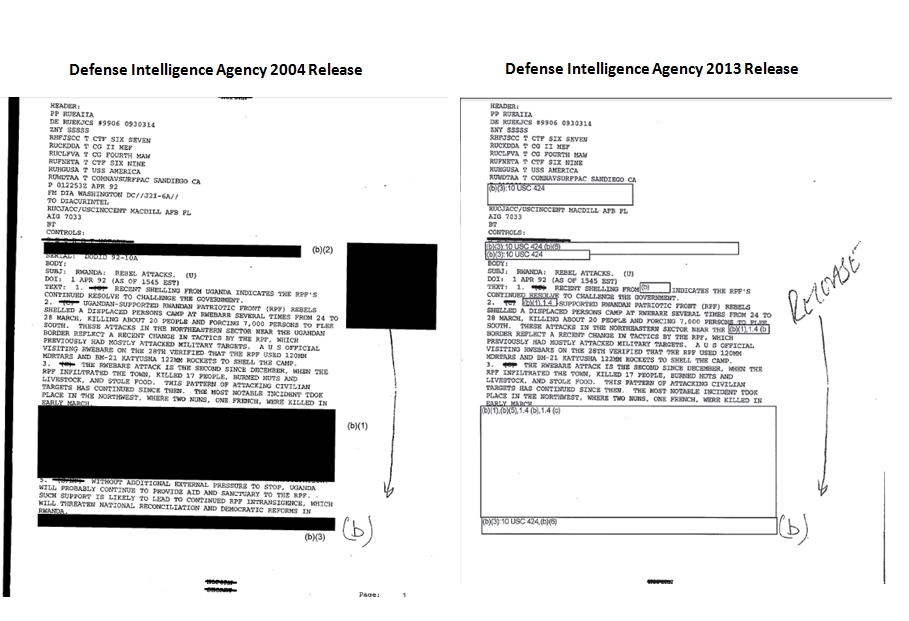
Here is a table comparing the 2004 and 2013 releases, with examples of “newly” redacted information: Table of 2004 vs 2013 Releases. The Archive recently filed an administrative appeal in this case.

These kinds of declassification reversals beg the question of whether the DIA took President Obama’s January 21, 2009 FOIA Memorandum directing all agencies to “adopt a presumption in favor of disclosure” and apply this presumption “to all decisions involving FOIA” seriously. The DIA’s latest disclosure makes me think not.

 UNREDACTED: The National Security Archive Blog
8 responses to “Rwandan Genocide: Declassification in Reverse”
Thanks for sharing this, Emily. Presumably the DIA doesn’t even have a record of the 2004 request in its system and just re-reviewed the entire batch from scratch.
Michael, good point, they probably do not even have a record of the original request. However, even if they did review it from scratch there is still the point that most of the information is already public knowledge from other extensive documents released (by State Department, and others), memoirs and scholarly projects, and some of it is just basic common sense, like the “Uganda” example.
As our empire expands and puts down roots in the form of bases it becomes necessary to hide the identities of people who are potential puppets of the empire. US activities in Africa will increase in the coming decades to secure the natural resources needed for the expanding digital universe.
This is just one set of criminals trying to protect their future puppets.
The sensitivity toward Africa is curious. No, I am not trying to draw some weird parallel to the current POTUS. It makes one wonder about our policy (such as it is) toward African states and their political entities.
Fred M. – While this specific example is from Africa, the problem of over-classification and inconsistencies in the review process are wide ranging on many different topics from US foreign policy in Latin America, to out-of-date cold war nuclear information. Unfortunately, this is just one example of many.
its also about current mindset –
more redaction less transparency
the better- there’s only privacy for govt- we cant redact when we are surveilled!
[…] Rwandan Genocide: Declassification in Reverse (nsarchive.wordpress.com) […]
[…] –no matter how improper continued classification may be in reality. This applies even to truly ”stupid secrets,” such as the Department of Defense’s recent decision […]