
A recent New York Times article highlighted the problematic and excessively secretive nature of the Foreign Intelligence Surveillance Act (FISA) Court, the entity that gives the National Security Agency (NSA) the legal go-ahead to conduct its massive surveillance operations. The Times article pointed out that its unclear if the phone companies that are forced to hand over their records to the NSA are even allowed to appear before the Court to dispute the orders, though some companies are more eager than others to help the NSA bypass personal privacy.
The renewed debate regarding the nature of the Court, thanks to Edward Snowden’s leaks of its otherwise secret rulings, provides an opportunity to examine the documentation surrounding its creation.
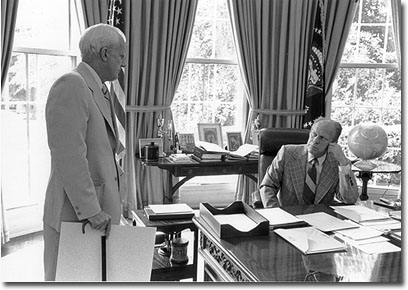
The Court was formally established in 1978 by the Foreign Intelligence Surveillance Act to review applications for monitoring the communications of American citizens suspected of involvement in espionage or terrorist activities. The legislation was both a result of concerns over the NSA’s domestic surveillance practices of the 1970s, as well as over the findings of the Church Committee’s investigations into Richard Nixon’s abuses of federal authority to spy on his rivals.
FISA was signed into law by President Carter, but the debate over the NSA’s warrantless wiretapping began during the Ford administration. A March 1976 memo from White House counsel Philip Buchen details President Ford’s ultimate support of legislation to regulate the NSA’s wiretapping of American citizens only after strong objections from Donald Rumsfeld, G.H.W. Bush, and Henry Kissinger were overcome. The Ford administrations’ internal decision-making process involved making several “pros” and “cons” lists. The “cons” lists included the argument that oversight of wiretapping policies “requires resort to the judiciary for exercise of an inherent Executive power.” On the “pros” side was the winning argument that legislation would provide legal protection for government officials and telecommunications companies from criminal liability for wiretapping, a practice they were likely going to continue with or without the legislation. At least with legislation in place they would be legally covered for doing it.
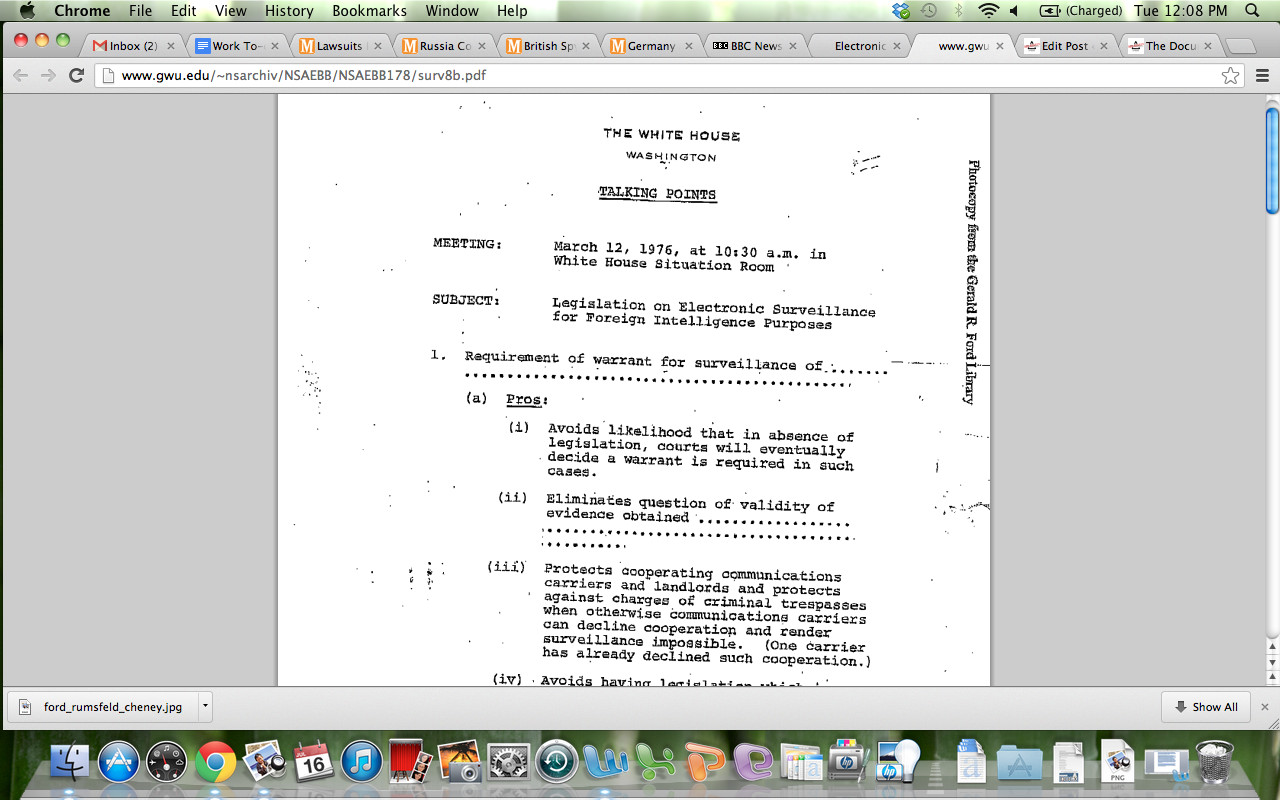
Visit the Archive’s posting, Wiretap Debate Déjà Vu, to read some of the fascinating documents behind the evolution of the Court—from the Ford administration’s debates surrounding FISA in the 1970s through the Bush-era amendments to the Act in the wake of the September 11 attacks that bypassed the Court altogether—and learn more about the roots of the intelligence community’s secret court.

 UNREDACTED: The National Security Archive Blog
2 responses to “The Documents behind the Birth of FISA, the Invisible Hand Granting NSA’s Surveillance the Legal ‘OK’”
[…] Also this week, the Foreign Intelligence Surveillance Court (FISA), which gave the legal ‘OK’ for the NSA surveillance practices, sided with Yahoo in a small legal victory for the internet corporation. Yahoo argued, and won, that the Justice Department must release and declassify the FISA court opinion proving Yahoo’s 2008 opposition to cooperating with the NSA’s PRISM program—unlike Microsoft, which went out of its way to help the NSA bypass encrypted data on its Outlook.com portal “before the product was even launched to the public.” […]
[…] the question why the government is paying AT&T for information communications companies are legally required to turn over anyway. However, AT&T is involved in more than just providing data, at a cost, to […]