
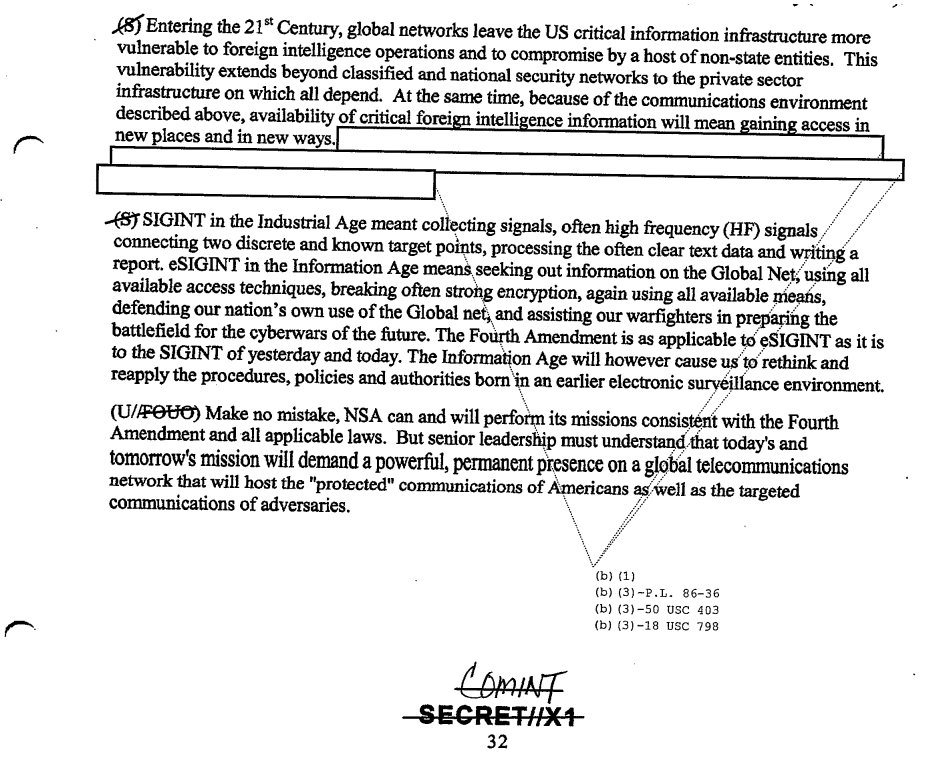
The National Security Agency (NSA) has been pushing to “rethink and reapply” its application of the Fourth Amendment since before 9/11. This was necessary, it argued, to attain a “powerful, permanent presence on a global telecommunications network.”
According to a declassified document posted by the National Security Archive and featured in a recent Politico article, in addition to attempting to re-frame the way we think of our right to privacy, the NSA has also received a robust infusion of funds after 9/11, paving the way for the Orwellian surveillance state Edward Snowden helped reveal. In light of recent events, the declassified record on the NSA is especially enlightening. Jeffrey T. Richelson’s recent posting of 98 newly declassified government documents tracing the Agency’s wide range of cyber activities, concerns, and attitudes since the Clinton administration is a must read. Some of the most notable revelations found in the declassified documents include:
- The NSA’s push to “rethink and reapply” the nature of the Fourth Amendment as early as 2001.
- The estimation that by January 2001, 60% of the Presidential Daily Briefings were based upon SIGINT, a percentage that has surely increased over the last decade.
- The NSA’s goal to selectively increase production of information from the global network.
- And the NSA’s quest to deploy tools efficiently to sort, process, move and store information.
Give the National Security Agency analysts some credit, though. They did correctly predict the queasiness of many Americans to having the entirety of their digital lives captured and stored:
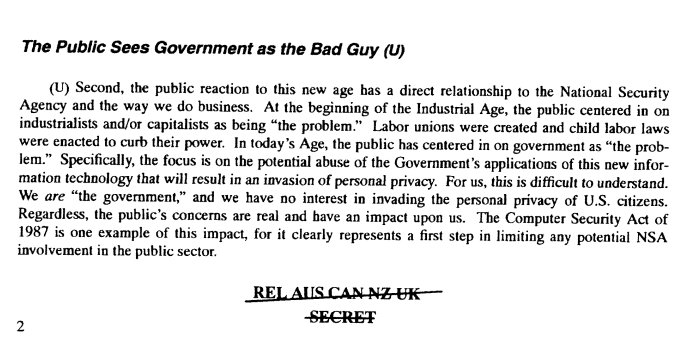
Delve deeper into the declassified NSA documents for yourself here and here, and trace the path the NSA took to avoid becoming “the bad guy.”

 UNREDACTED: The National Security Archive Blog
10 responses to “National Security Agency has pushed to “rethink and reapply” its treatment of the Fourth Amendment since before 9/11”
Connecting the dots, if people were paying just a little closer attention, with 30% of security clearances in the private contractor sector (recalling Snowden was at Booz Allen Hamilton and not at the NSA per se), what is become clear is, Prism can serve to inform corporate boards at the deepest levels of anyone opposed to their agendas, draw up their own ‘kill lists’ were it a desired thing to do, track anyone onto illegal activities for purposes of derailing investigations into corporate (or government) crime, et cetera, add nausea.
Recalling it was DoJ attorney (and now outgoing FBI Director) Robert Mueller effectively quashed the BCCI money laundering investigation, covering Iran-Contra weapons and narcotics trafficking money pipelines, don’t be surprised at Obama’s pick to replace Mueller at FBI headquarters with (BCCI’s replacement) HSBC board director James Comey. Prism should serve organized crime in government well-
[…] a declassified 2001 NSA memo posted by the National Security Archive, the NSA has been pushing to “rethink and reapply” its application of the Fourth Amendment and its interpretation of U.S. citizens’ right to […]
[…] daily brief comes from many different agencies, a significant portion has come from the NSA, especially its Prism program — a top secret program that tapped into the databases of a […]
[…] daily brief comes from many different agencies, a significant portion has come from the NSA, especially its Prism program — a top secret program that tapped into the databases of a […]
[…] president’s daily brief comes from many different agencies, a significant portion has come from the NSA, especially its Prism program — a top secret program that tapped into the databases of a large […]
[…] daily brief comes from many different agencies, a significant portion has come from the NSA, especially its Prism program — a top secret program that tapped into the databases of a […]
[…] the president’s daily brief comes from many different agencies, a significant portion has come from the NSA, especially its Prism program — a top secret program that tapped into the databases of a large […]
[…] daily brief comes from many different agencies, a significant portion has come from the NSA, especially its Prism program — a top secret program that tapped into the databases of a […]
[…] president’s daily brief comes from many opposite agencies, a significant portion has come from a NSA, generally a Prism program — a tip tip program that tapped into a databases of a vast […]
[…] president’s daily brief comes from many different agencies, a significant portion has come from the NSA, especially its Prism program — a top secret program that tapped into the databases of a large […]