
On Monday, Wikileaks “released” the “Kissinger Cables,” (also called the Public Library of US Diplomacy or PlusD) a fascinating collection of 1.7 million U.S. diplomatic correspondences from the mid-1970s. The cables are easily sifted through thanks to the sleek, high-powered search function Wikileaks built for their “release,” making the collection all the more appealing to document hounds. As a result, documents that would likely have fallen through the cracks if not for the interest generated by all-things Wikileaks are receiving much deserved attention and are producing some very important revelations.
The only problem is, Wikileaks didn’t “release” the cables. They were released electronically by the National Archives and Records Administration in 2006. While the Wikileaks site is obviously more user-friendly (see graphic below), it is unfortunate that the original source of the documents has been misidentified, that Wikileaks was not more upfront in their origin, and that the hard work done by NARA staff has gone largely unrecognized. The documents were not, as Julian Assange claimed, “hidden in the borderline between secrecy and complexity;” they were clearly posted on the website of the National Archives. The National Security Archive and many other researchers have made frequent use of the cables since they were posted in 2006. Here’s just one example of a cable The National Security Archive posted about how Secretary of State Henry Kissinger issued a demarche to aides who wanted to “head off” a “series of international murders.”
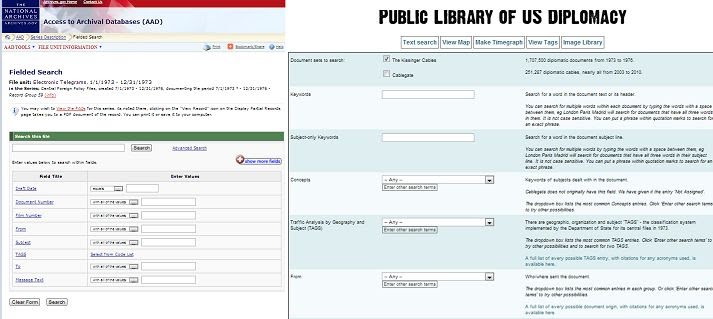
As a frequent FOIA requester, it seems to me that Wikileaks’ portrayal of US declassifiers acting somehow sinisterly does a disservice to the National Archives and Department of State, two of the better FOIA agencies.
But, notwithstanding Wikileaks’s less than transparent branding (or rebranding) of these documents declassified by the US government, the fact remains that Wikileaks has sparked a far broader and greater interest in this history than NARA has been able to.
As an archivist, I believe that bringing important documents to light and making them easily searchable for public consumption is a good thing; for that, kudos to Wikileaks. But most importantly, as a FOIA and transparency advocate, I hope that the interested generated by Wikileaks’ “release” of these already-released documents will be a wake-up call to federal agencies like NARA, which has been dragging its feet releasing the next series of 1977-1980 Department of State cable collections despite President Obama’s orders to adopt a “presumption in favor of disclosure” and his instruction to declassify the 400-million page backlog of documents marooned at the Archives by December 2013. (Chances are slim NARA will meet that deadline).
If federal agencies do not take Obama’s FOIA memorandum to heart and release, package, and publicize their documents more effectively, there will be a growing space for Wikileaks and others to take credit for their hard work. Fully embracing the digital-age industry standard of conducting the FOIA and declassification business electronically, –which means posting easily searchable versions of all documents as they are released– will go a long way in preventing agencies from getting “scooped” on their own, public documents. Or worse, having them actually leaked.

 UNREDACTED: The National Security Archive Blog
One response to “When Wikileaks “Scoops” NARA on Their Own Publicly Available Documents, It’s Time for Agencies to Fully Embrace Effectively Digitizing All-Things FOIA”
You are leaving out a key part to the reason why the documents were gathered and released by Wikileaks; They were disappearing. 1000’s upon 1000s of the documents had been reclassified. Our American history, ney, Global history was being taken from humanity. The US of A could not be trusted with the document any longer.