
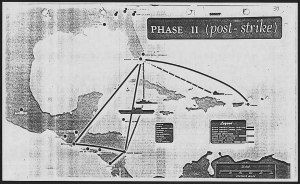
Last week, the National Security Archive filed its appeal in the Washington DC District Court over the release of the fifth and final volume of an internal CIA history of the Bay of Pigs invasion. The Archive’s FOIA lawsuit has already won the release of three volumes (a fourth was released by the JFK assassination review board). The CIA (supported by the Department of Justice) had argued that volume five (but not the other volumes, head scratchingly) must be withheld under the b(5) deliberative process exemption, because its release could “confuse the public.”
Clifford Sloan and Allon Kedem of Skaden, Arps, Slate, Meagher, and Flom have written a bang up brief explaining why Judge Gladys Kessler’s decision that the CIA can censor this history because it “does not want to discourage disagreement… among its historians” was incorrect.
Give the brief a read for yourself; it’s very interesting, even if you haven’t passed the bar. Below are its main arguments:
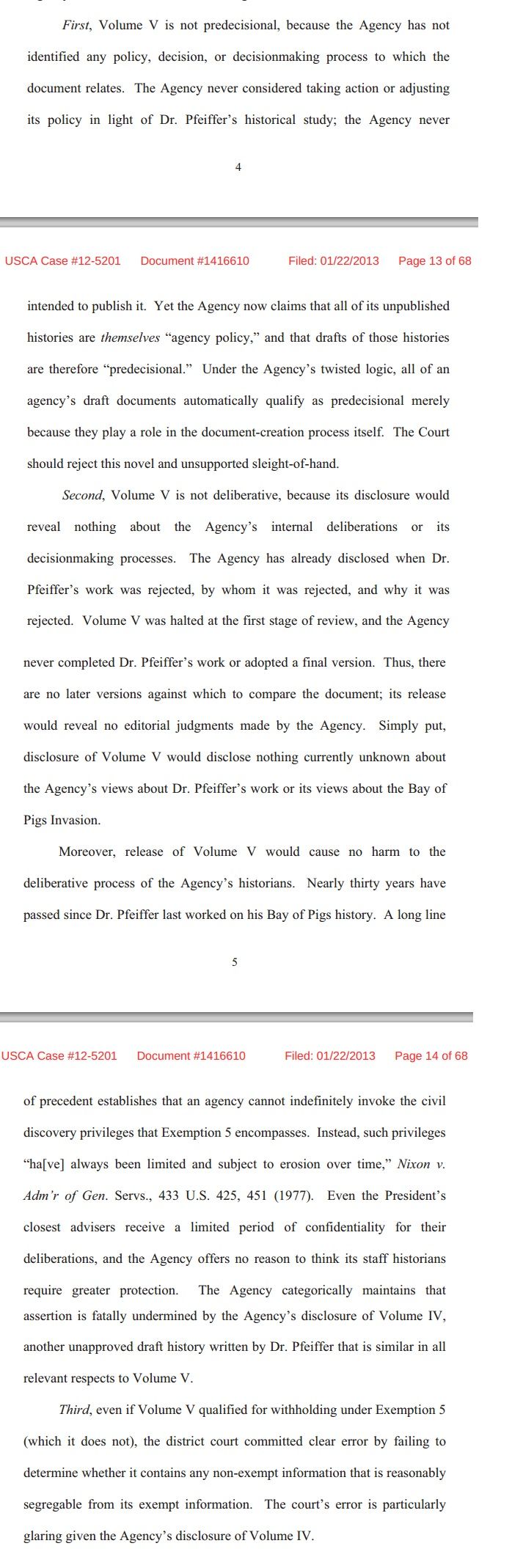
- Three additional points in the brief worth mentioning: First, the Department of Justice has issued FOIA guidelines to all agencies instructing, “for all records, the age of the document” is a “universal factor[] that need[s] to be evaluated in making a decision whether to make a discretionary release.” It is unclear why the Department of Justice is defending an agency that did not follow its own advise. I do not know of any recent cases of the DOJ refusing to defend an agency FOIA position, even especially egregious positions.**
- The Federal Open Market Committee of the Federal Reserve, which sets monetary policy for the entire nation, effecting the global economy, publicly releases the transcripts of its regular and emergency meetings on a five-year delay. Claims that the deliberations of Agency history staff are more sensitive than policymakers fending off fiscal crises are tough to swallow. (Here are the Fed’s minutes as the fiscal crisis began.)
- Finally, the President himself can shield his internal deliberations at the highest pinnacle of power for only twelve years after he leaves office. Will CIA historians be allowed to claim an indefinite prdecisional exemption, dwarfing even what is afforded to the president and his advisers?
We’ll update when the date for oral arguments is set in this pivotal FOIA case.
**The Department of Justice Office of Information Policy could have explained its position at Transparency in the Obama Administration, A Fourth-Year Assessment, an annual FOIA symposium where it was invited to attend. It was hosted by the law professor and former Department of Justice Office of Information and Privacy director organized by Dan Metcalfe. During each of the panels, he left a chair open on the dais, should an office staffer from DOJ OIP show up. The chair remained empty for the entire day.

 UNREDACTED: The National Security Archive Blog
2 responses to “National Security Archive Files Appeal Explaining Why CIA is Dead Wrong to Claim The “Predecisional” Exemption for Its History of the 1961 Bay of Pigs Invasion.”
[…] the United States Court of Appeals for the District of Columbia Circuit in our case against the CIA to release the fifth and final volume of an internal CIA history of the Bay of Pigs invasion. The Archive’s FOIA lawsuit has already […]
[…] claim that the entire universe of “predecisional” documents–including any claimed “draft”–should be withheld from the […]