

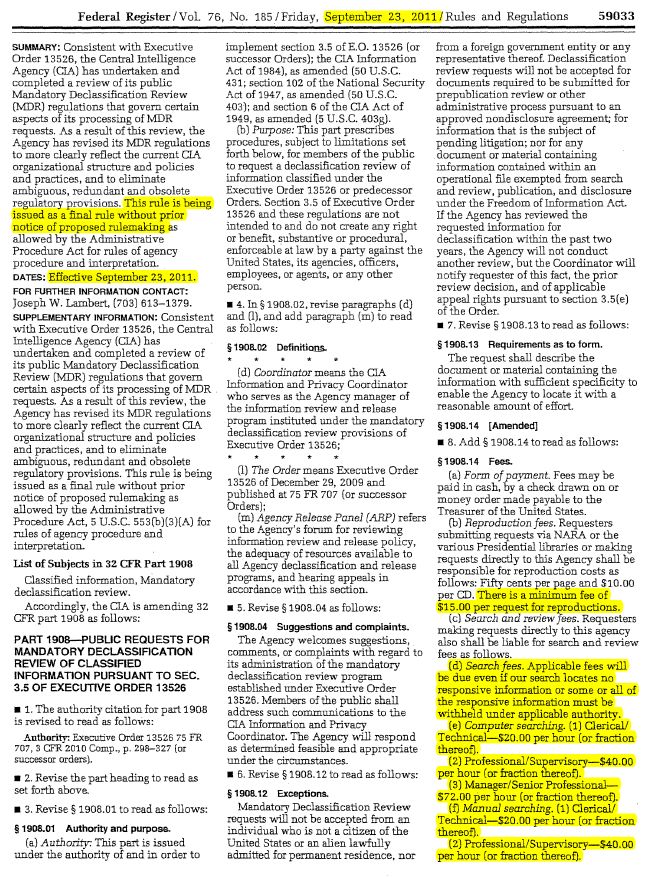
This very important Document Friday features a very obscure document, just two pages (59033 and 59034) that the Central Intelligence Agency printed in the Federal Register on Friday, 23 September 2011 –without a notice for public comment. These regulations, which the CIA began enforcing in December, are a covert attack on the most effective tool that the public uses to declassify the CIA’s secret documents, Mandatory Declassification Review (MDR).
Overnight, without public comment or notice, the Agency decreed that declassification reviews would now cost requesters up to $72 per hour, even if no information is found or released. To even submit a request –again, even if no documents are released— the public must now agree to pay a minimum of $15.
Mandatory Declassification Review is an extremely powerful tool because it eventually allows declassification decisions to be removed from the control of the overly-secretive CIA and decided by an independent, rational, democratic, outside entity. First, the requester must request a document under MDR and exhaust his appeal. Then, according to President Obama’s executive order on classified information, he can invoke what is sometimes called the “secrecy court of last resort,” the Interagency Security Classification Appeals Panel (ISCAP). ISCAP has certainly proven the most effective means that the National Security Archive has used to pry the release of documents from the CIA.
ISCAP is composed of senior-level representatives appointed by the Departments of State, Defense, and Justice, the National Archives, the Office of the Director of National Intelligence, and the National Security Advisor. These senior representatives review classified documents, and vote to determine if some or all of the information can be released without harming US national security –majority vote rules. According to the most recent US government report on classification, these officials have overruled agencies –certainly including the CIA– in more than 65 percent of their decisions since 1996. And now, to avoid this accountability and oversight, the CIA is trying to price users out of turning to ISCAP.

MDR and ISCAP are certainly more effective tools for requesting documents from the CIA than the Freedom of Information Act (FOIA). After the CIA denies a FOIA request and a FOIA appeal, requesters have the right to go to court, but that’s expensive and risky business– judges are frequently overly-deferential to dubious CIA claims for the need of secrecy. (For one example, see the CIA’s recently brief to a US federal judge stating that it would not release a volume of a three-decade-old history of the 1961 Bay of Pigs debacle because it would “confuse the public.” For another, see the CIA’s tooth-and-nail fight against releasing a 95-year-old invisible ink recipe, available on google scholar.)
To prevent requesters from an independent review of their requests by ISCAP, the CIA amended its regulations –without allowing for public comment, as is required the Administrative Procedure Act– to allow charging astronomically high fees to process MDR requests. Even if no documents are found or released, the CIA’s rules now allow it to charge up to $72 dollars per hour of review time. Furthermore, each requester must now agree to pay a minimum of $15 dollars before the CIA will even accept their request — again, that’s regardless if the CIA finds or releases anything.

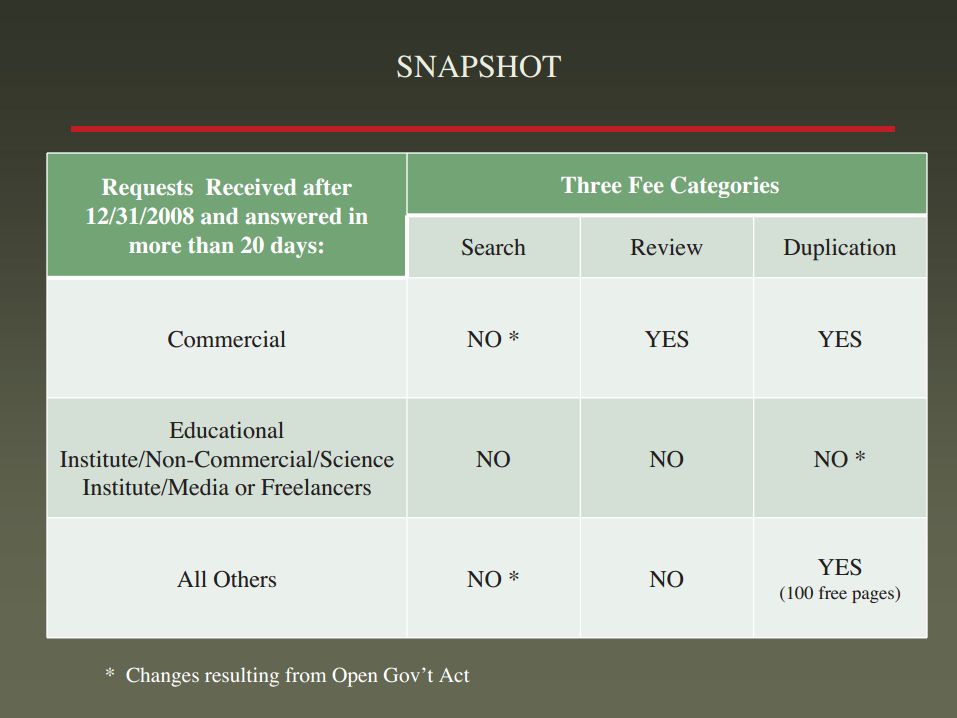
Compare these exorbitant fees to those charged for FOIA requests. Before the CIA surreptitiously changed its regulations, its MDR fee structure was “in the same amount and under the same conditions as specified in [the Freedom of Information Act] 32 CFR part 1900.” The Freedom of Information Act stipulates that public interest, educational, journalism, and other fee waivers must be granted by agencies where applicable. Under the bipartisan 2007 Open Government Act, Senators Leahy and Cornyn crafted amendments to FOIA which now force agencies to forfeit their right to collect some FOIA processing fees when they miss their processing deadline, an extremely common occurrence at the Agency. The CIA’s new MDR regulation, which allows it to claim that unlike FOIA, “there are no fee categories in processing MDRs” is clearly a step back for access to government information.
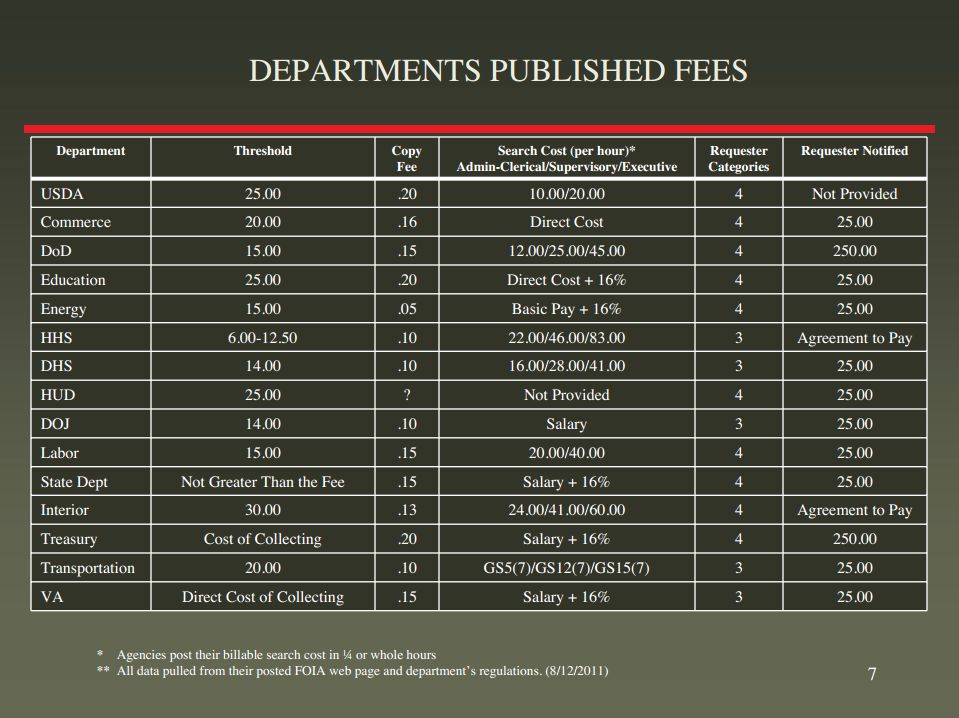
Furthermore, the fees the CIA is now charging for MDR reviews are astronomically more expensive than the FOIA fees charged by other agencies. And no other federal agency mandates a minimum payment, especially if no information is found or released. This was certainly not a good-faith effort to recoup costs by the CIA.
Fortunately, regulations can be repealed. Late last year, an outraged public forced the Department of Justice to withdraw a regulation that would have allowed it to lie to FOIA requesters. The condemnation of Senators Grassley, Udall, Leahy and Representative Smith forced the Department of Justice to recall its damaging regulation. Will Congress act to stop this retrograde regulation as well?
And what about President Obama –who recently pledged to the leaders of 46 other countries that he would “streamlin[e] the declassification process throughout the federal government”? What has his administration done to counter this covert, harmful, and anti-openness CIA regulation? Nothing yet. So far it appears that the CIA’s sneak attack on the”new era of open government” is flying under White House’s radar.
The more that agencies are allowed to issue covert, transparency-stifling regulations without public comment, the closer the United States looks to a “managed democracy.” The longer the White House stands on the sidelines as agencies openly defy its instructions on openness, the more it appears that the entrenched secrecy establishment of the United States really is “literally out of control.”
Let’s fight to reverse these trends, beginning with the repeal of this nefarious CIA attack on open government.

 UNREDACTED: The National Security Archive Blog
34 responses to “The CIA’s Covert Operation Against Declassification Review and Obama’s Open Government”
And one of my FOIA lawyer friends has just informed me:
“The $15 threshold is for duplication only. Not a total minimum. So if you file an MDR request for a 2-page document, and agree to pay all charges, here’s how it breaks down: $35 for search, $100 for review, $15 for duplication. Total of $150, instead of $136, had the minimum not been there. That’s even worse than what you wrote.”
Wow.
My friend continues, “On the 50 cent/page issue, it should also be noted that, just to be equally unfair, the CIA also published a proposed rule on 9/23 which, when finalized, will change the FOIA duplication charge to 50 cents/page as well.”
http://www.gpo.gov/fdsys/pkg/FR-2011-09-23/html/2011-21577.htm
Reblogged this on NonviolentConflict.
[…] -Friend of the blog Nate Jones criticizes the CIA for resisting open government [National Security Archive] […]
I agree. Let’s fix it. Now, how about providing us with a name, contact information, and specific information so we can pitch in and get it fixed.
[…] (8) The CIA’s Covert Operation Against Declassification Review and Obama’s Open Government &… […]
[…] (8) The CIA’s Covert Operation Against Declassification Review and Obama’s Open Government &… […]
[…] (8) The CIA’s Covert Operation Against Declassification Review and Obama’s Open Government &… […]
[…] (8) The CIA’s Covert Operation Against Declassification Review and Obama’s Open Government &… […]
fear in the government, that’s a good sign
[…] The CIA’s Covert Operation Against Declassification Review and Obama’s Open Government &… 35 minutes ago Bookmark the permalink. ← He apoyado la petición S… RT @DirDigEng: […]
[…] The CIA’s Covert Operation Against Declassification Review and Obama’s Open Government “This very important Document Friday features a very obscure document, just two pages (59033 and 59034) that the Central Intelligence Agency printed in the Federal Register on Friday, 23 September 2011 –without a notice for public comment. These regulations, which the CIA began enforcing in December, are a covert attack on the most effective tool that the public uses to declassify the CIA’s secret documents, Mandatory Declassification Review (MDR).” https://nsarchive.wordpress.com/2012/02/10/the-cias-covert-operation-against-declassification-review-… […]
[…] background and a critique of the new CIA policy, see “The CIA’s Covert Operation Against Declassification Review” by Nate Jones in the Archive’s Unredacted blog, February 10. {"lang":"en-US"}Email […]
I have a question.
To whom, or of whom, is one supposed to direct a complaint to (which Congress persons, for example) so that they know this bureaucratic chicanery is taking place? And that we can ask for a “claw-back/repeal remedy”?
I think that Nate Jones should write a follow-up piece here so we can have instructions on what the hell to do.
This should not stand.
Thanks James and Allan,
I think the most useful pressure points may be:
The Information and Security Oversight Office http://www.archives.gov/isoo/ which is responsible for classification decisions and regulations throughout the federal government.
The House Oversight Committee http://oversight.house.gov/
Senators Cornyn http://www.cornyn.senate.gov/public/ ,
Grassley, http://www.grassley.senate.gov/
and Leahy http://www.leahy.senate.gov/, who have staunchly fought for access to government information in the past.
And perhaps, most importantly, the White House, which pledged to Americans and other countries (in the Open Government Partnership) to increase public access, not decrease it. info@opengovpartnership.org
I know that Cass R. Sunstein http://www.whitehouse.gov/omb/inforeg_administrator and Steven Croley are two of the President’s key point people on open government issues, but they have no public contact info.
And stay tuned. The National Security Archive is certainly going to keep up the fight. I’ll update the steps we take as they become public.
Thanks for the support in fighting this terrible regulation.
Thanks for bringing this to the attention of the public, Nate; I was unaware of the change. I use FOIA and MDR, including for CIA records requests, and this will impose a burden on me.
The FOIA and MDR processes are useful tools that help the public exercise oversight of government; these laws and regulations serve the public interest, whereas CIA over-classification and obstruction of public inquiry do not. Imho, the expenses incurred in searching, reviewing and duplication are a worthy use of tax revenue.
Even at the low end – $20/hr for clerical level searching – it seems like a premium’s being added. And, given that this will reduce the public’s ability to use the MDR process to compel the release of records, and given the CIA’s dirty history and its penchant for secrecy, I’m skeptical these fees are being imposed simply to cover costs.
“… the CIA amended its regulations –without allowing for public comment, as is required the Administrative Procedure Act.”
If this is the case, would there be value in reporting this violation to some oversight authority?
What is the likelihood this new rule would be suspended as a result?
I’m also intrigued by the mention of a 20 pg Tenet rebuttal to the CIA OIG 9/11 report, which I had not head of before, and was not able to find by searching Google News Archive, Global NewsBank or Lexis-Nexis, even with the most basic keywords. Would you post a link, or provide a little more detail on this?
Many thanks Eric. The Administrate Procedure Act “avenue” could certainly be a valid one. But from my point of view, “the most transparent administration ever” could resolve this controversy with one phone call. Hence, political actors may be more useful pressure points. Of course I’m not ruling anything out.
As for the Tenet rebuttal, it was cited here:
http://www.cbsnews.com/stories/2005/10/11/opinion/main933450.shtml
In the paragraph beginning “More importantly…”
Bringing this to the attention of Obama would be good, possibly fruitful. If he fails to do anything, it will be another mark on his 3 year record of mostly hypocrisy and failure concerning transparency and accountability. I’ll send an email to the WH w/ a link to this blog, and check back for updates on the issue.
Thx for the link.
fyi; just sent this thru the WH contact form:
The CIA recently imposed overly burdensome fees for Mandatory Declassification Review (MDR) requests. I’m hoping President Obama or one of his officials will overturn this rule, as it frustrates the public’s oversight of an agency that is notorious for over-classification, a problem the president has repeatedly promised to solve.
Last September, without public notice or comment period (possibly violating the Administrative Procedure Act), the CIA published its new fee schedule in the Federal Register. The new rule imposes a minimum $15 charge for duplication, and makes requesters responsible for the full cost of searching and reviewing, at a minimum charge of $20/hr, and potentially up to $72/hr, even if no records are found or released.
A CIA MDR request response letter received by Nate Jones of the National Security Archive at George Washington University states that Mr. Jones/NSArchive are expected to commit to payment before the CIA begins searching, without knowing the total cost that might be incurred. [1] No information was provided in the letter concerning appeal of the fee burden.
FOIA and MDR help the public exercise oversight of government; these laws and regulations serve the public interest, whereas CIA over-classification and obstruction of public inquiry do not. In my opinion, the expenses incurred in searching, reviewing and duplication are a worthy use of tax revenue – especially in the case of the NSArchive, a respected institution which does not file frivolous requests.
President Obama has repeatedly promised to increase transparency and accountability, but has often fallen short. I hope he will at least remove this CIA-created obstacle to disclosure of US government records. It would also be good if the president issued an executive order declassifying the subject of Mr. Jones’ request; former CIA Director George Tenet’s 20-page rebuttal to the “OIG Report on CIA Accountability with Respect to the 9/11 Attacks” – as well as the report itself. If he does these things, history will judge his record concerning transparency and accountability a little less harshly.
Sincerely,
Erik Larson
1. Jones, Nate. “The CIA’s Covert Operation Against Declassification Review and Obama’s Open Government.” UNREDACTED: National Security Archive. February 10, 2012. https://nsarchive.wordpress.com/2012/02/10/the-cias-covert-operation-against-declassification-review-and-obamas-open-government
[…] background and a critique of the new CIA policy, see “The CIA’s Covert Operation Against Declassification Review” by Nate Jones in the Archive’s Unredacted blog, February 10. Like this:LikeBe the first to […]
[…] submitted a double entry for the Rosemary contest. In September 2011, Joseph Lambert of the CIA rammed through without notice or comment a new set of regulations restricting the Mandatory Declassification Review process. The regulations […]
[…] Here’s a brief rundown on the CIA’s attack on MDR. More info can be found here. […]
[…] September 23, 2011 the CIA launched a covert attack on Mandatory Declassification Review (MDR) by entering new regulation changes into the Federal […]
[…] National Security Archive accurately points out, “Mandatory Declassification Review is an extremely powerful tool because it eventually allows […]
[…] Thirty-six groups have signed on to fight to force the CIA to repeal new regulations which charge the public outrageous fees for the opportunity to challenge its secrecy claims. The fees, which can run requesters up to $72 per hour even if no information is found or released, effectively cut off access to a system that researchers, historians, public interest advocates and others have used successfully to challenge the CIA’s extreme secrecy — the Mandatory Declassification Review process. For background of how –and why (to evade accountability)– the Agency did this, see here. […]
[…] National Security Archive accurately points out, “Mandatory Declassification Review is an extremely powerful tool because it eventually allows […]
[…] more background, and to read the letter we sent the Agency, see […]
[…] more background, and to read the letter we sent the Agency, see […]
[…] more background, and to read the letter we sent the Agency, […]
[…] our friends over at the National Security Archive alerted us to a few pages in the Federal Register that describe the Central Intelligence Agency’s […]
[…] our friends over at the National Security Archive alerted us to a few pages in the Federal Register that describe the Central Intelligence Agency’s […]
[…] Friday September 23, 2011, the Central Intelligence Agency snuck two pages into the Federal Register –without a notice for public comment. These two pages […]
[…] to suspend implementation pending the lawsuit’s outcome. The CIA’s attempt in this instance to price requesters out of filing requests is antithetical to the principles of open government, or a sustainable system […]