
Update: Remember the time that a member of the Department of State wrote that designating Pakistan a state sponsor of terror was a “bunch of crap!!” and how the DOS tried to hide it? Well, just in case you have, I’m reposting.
Of course, there are lots of countries that sponsor terrorism that the US does not designate as state sponsors of terrorism. Doing so to Pakistan would certainly have harmed our “alliance.” At any rate, the Resolution’s indictment of the Pakistani government and Inter-Service Intelligence for –among other things– “provid[ing] refuge and assistance to [the Taliban and] Osama Bin Laden” appears to have been accurate, not “a bunch of crap!!”
Here are more docs demonstrating Pakistan’s unwillingness to cooperate on anti-terrorist operations, and here is the National Security Archive’s Osama bin Laden File.
And I’m still waiting to hear from a graphologist.
—————-
One of the happiest moments a FOIA requester has is when he (or she) wins a FOIA appeal and gets to see what exactly the government was trying to hide.
Here, have a try. It’s fun.
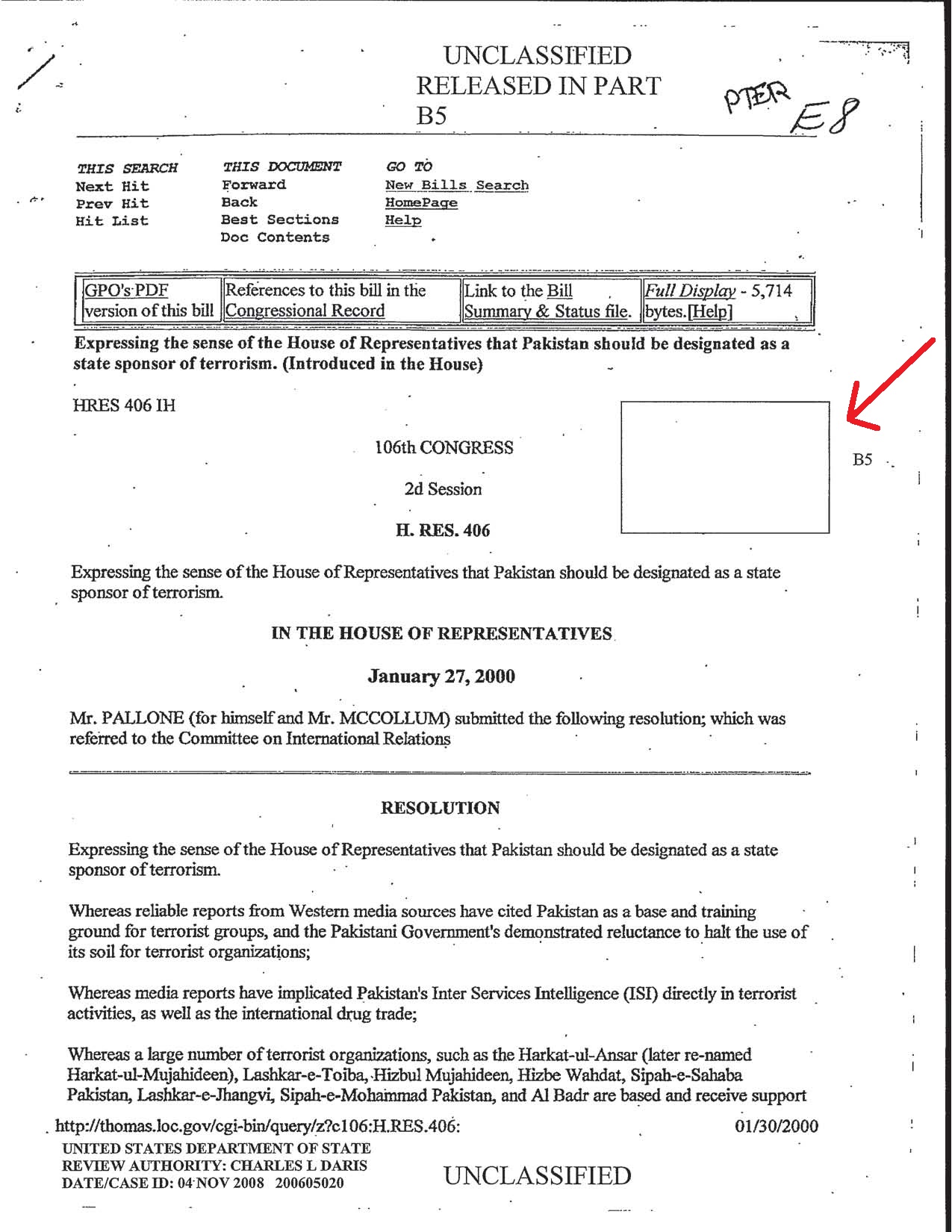
And below is the document we received two years later, after Barbara Elias –the indefatigable director of the National Security Archive’s Afghanistan/Pakistan/Taliban Documentation Project– crafted and won an appeal to the Department of State’s Appeals Review Panel.
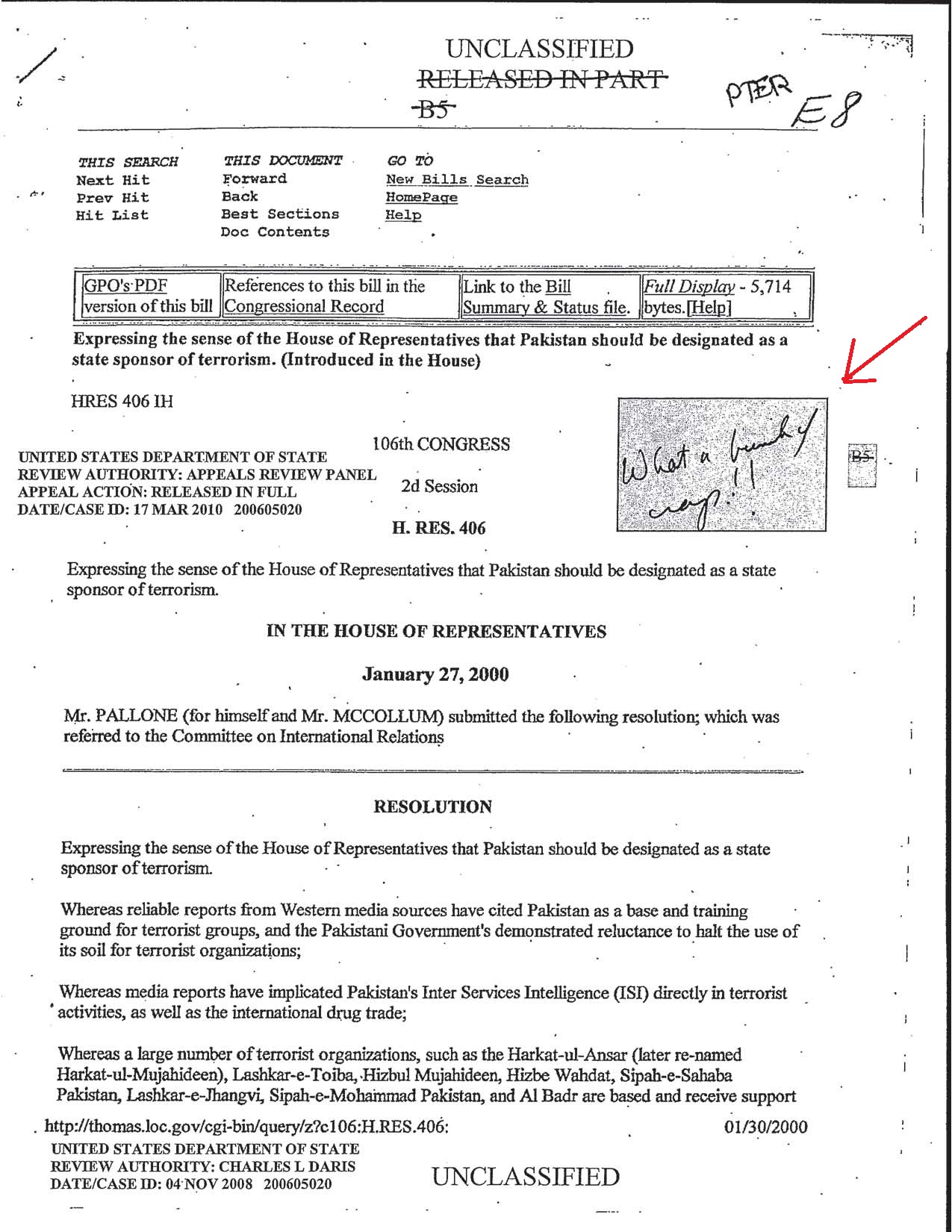
Yes, you read that right. The Department of State really withheld the phrase, “What a bunch of crap!!”
Having won this game of documentary hide and seek, I had a hearty chuckle, finding it quite funny that 1) a person employed by the Department of State (I don’t know who– are there any graphologists out there?) would write “bunch of crap!!” on a copy of a House resolution, and 2) that the Department of State had tried so hard to prevent the public from knowing it had ever happened.
Then I realized that maybe the situation wasn’t so funny. For two reasons: the first related to historic US policy, the second related to current US policy.
Let’s start with the history. As you can see, “What a bunch of crap!!” was scrawled on a copy of House Resolution 406 that “express[ed] the sense of the House of Representatives that Pakistan should be designated as a state sponsor of terrorism.” The resolution –submitted by a Democrat and a Republican to a Republican-controlled House– was eventually referred to a subcommittee where it died, perhaps for political reasons.
A reading of the resolution shows that many of the representatives’ concerns were farsighted. It indicted the government of Pakistan for harboring various terrorist groups (including Lashkar-e-Toiba), for being one of only three countries which recognized the Afghan Taliban, and for hindering US and international efforts to apprehend Osama Bin Laden.
One year and ten months before the 11 September attacks, the resolution’s plea that “those countries that harbor terrorist organizations or provide them with technical, financial, political or other support should…be held accountable” was prescient, indeed. With the benefit of hindsight, we know that concerns about Pakistan and terrorism was were not “a bunch of crap.” Ask Richard Clarke.
My second concern is with with current US Freedom of information policy. In short: Why was so much time, effort, and money spent to redact this harmless bit of chicken scratch? Merely to prevent government embarrassment?
Ostensibly, the note was redacted under the b(5) exemption for “interagency or intra-agency communications forming part of the deliberative process, attorney-client privilege, or attorney work product.” This justification is murky at best.
It’s even murkier when one examines the second page of the document and sees that other –less profane– marginal notes (also ostensibly “deliberative processes”) were not redacted. It appears to me that State’s redaction was to prevent embarrassment rather than prevent harm to the interagency process or national security.
Furthermore, Attorney General Holder even instructed declassifiers that they “should not withhold information simply because [they] may do so legally.” He also “strongly encourage[d]” the “discretionary disclosures of information.” Perhaps State didn’t get the memo?
Of course, to State’s credit, the Appeals Panel did get the decision right the second time around; the Panel frequently releases addition information on appeal. (And this “FOIA foible” aside, the Department of State is actually one of the better declassifying agencies.)
But my concerns remain. What if Barbara Elias had not been so dogged as to stick with this request for years until it was finally fully released? What if the Department of State Appeals Panel had been as subjective as the original reviewer? Which other government secrets remain incorrectly hidden under black ink? Are we really safer in the dark?

 UNREDACTED: The National Security Archive Blog
14 responses to “Document Friday: Someone from the Department of State thought that punishing Pakistan for “providing refuge and assistance” to Osama bin Laden was “a bunch of crap!!””
Wow, what a GREAT post. Thanks for sharing! Quite a good example of abuse of the b(5) exemption. It really makes you wonder what else they are hiding under all of those other black boxes…
[…] logs about incidents in Afghanistan and Iraq and a classified military video.‘ ‘Document Friday: The Department of State was Hiding…. THIS?!?!‘ More to follow on my […]
Good post. One minor correction though – the resolution wasn’t ’10 months before the 11 September attacks’, but a year and 10 months in advance of them.
Many thanks. Corrected.
i’ve just by now discover this internet page, pretty cool! ,
i’m going interested in those arguments( and especially looking for the nuclear tecnology story) after reading the book ” C.I.A. legacy of asces,” BY TIM WEINER .
thanks for your work!
[…] volta alla diffusione di documenti riservati ottenuti attraverso il FOIA) è riuscito ad ottenere una risoluzione proposta al Congresso il 27 gennaio del 2000 (1 anno e 10 mesi prima […]
Part of the “deliberative process,” I see. Nice catch Nate.
http://www.washingtonpost.com/wp-dyn/content/article/2011/01/11/AR2011011107031.html
🙂
Somehow I missed this the first time around…
It reminds me of a rather candid FBI record I got last year, which, to their credit, they didn’t try to redact. It was the “Notes” page of a FOIA request filed by Scott Hodes, a well-known FOIA attorney who used to work at the FBI. The note, summarizing a conversation between the FOIA analyst and Scott, read: “Requester also stated that he hopes with the new administration that Mr. Hardy [Head of FBI FOIA] gets what he deserves….a job shoveling snow…” (ellipses in original).
True story. It’s on page 6. http://www.nationalsecuritylaw.org/files/received/FBI/FOIA_processing_notes-Hodes.pdf. 🙂
[…] is probably the best in the government. They very frequently release additional information. (Here is one of my favorite examples.) I’ll update with the result. A key problem though, is […]
[…] Panel is probably the best in the government. They very frequently release additional information. (Here is one of my favorite examples.) I’ll update with the result. A key problem though, is that it […]
[…] Candid thoughts on b(5). […]
[…] Panel is probably the best in the government. They very frequently release additional information. (Here is one of my favorite examples.) I’ll update with the result. A key problem though, is that it […]
[…] from the public. A quintessential example of this sort of improper withholding can be found here — where the State Department annotated a document in a less-than-professional manner and tried to […]