
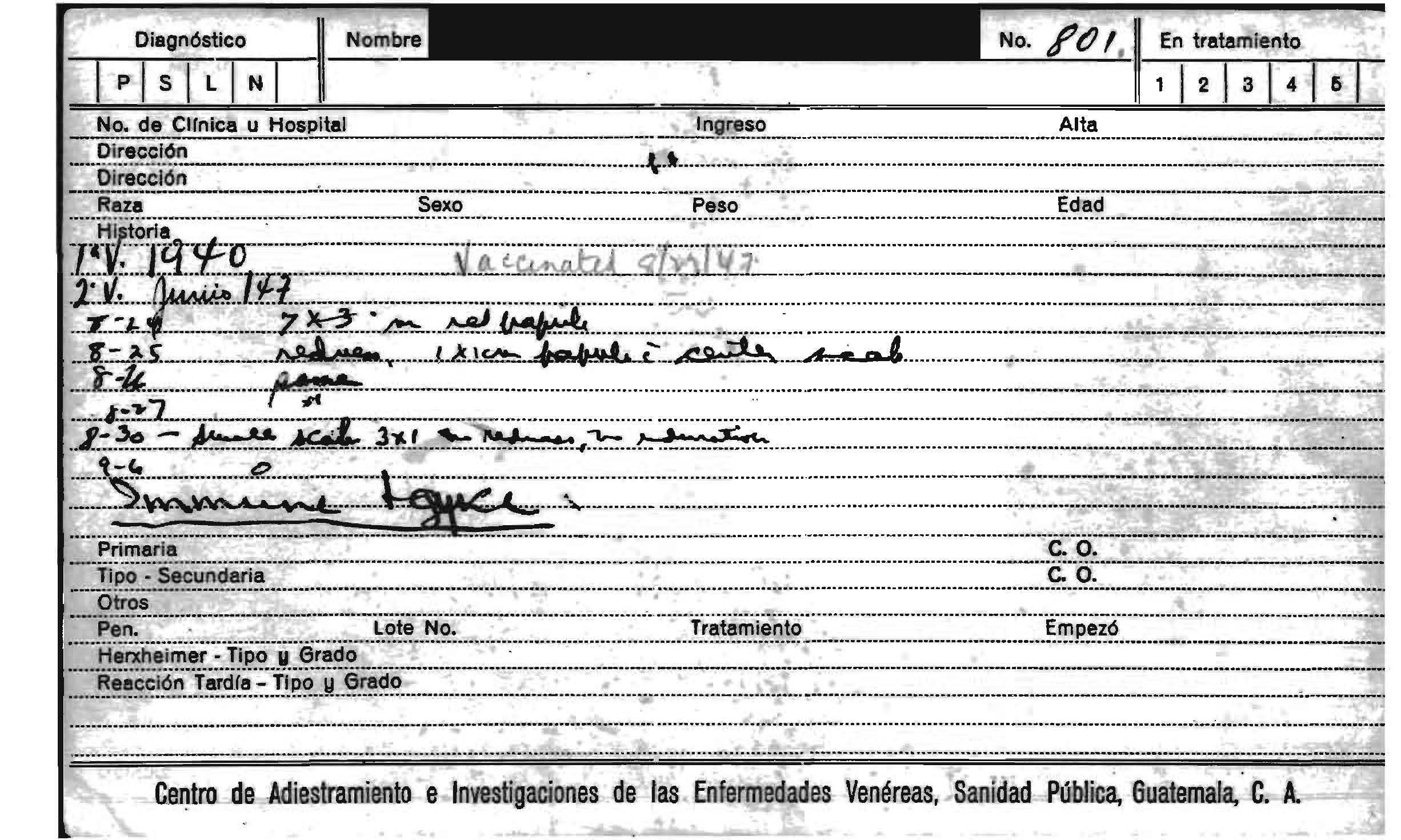
Washington, April 25, 2011—Between 1946 and 1948, U.S. public health researchers infected hundreds of Guatemalan prisoners, soldiers and mentally ill patients with syphilis and gonorrhea, without their knowledge or consent, in order to test the effectiveness of penicillin. The experiments were carried out in Guatemala under the cloak of confidentiality, and the results were never published in the United States. But after a scholar discovered archives chronicling the program at the University of Pittsburgh and published her findings last year, the U.S. National Archives and Records Administration (NARA) took custody of the documents and on March 29 made them publicly available.
In the press release issued by the National Archives, the collection is described as consisting of some 12,000 pages of reports, correspondence, patient records and graphic photographs of the effects of syphilis infection on Guatemalan subjects. The papers belonged to the late Dr. John C. Cutler, an expert in sexually transmitted diseases and a leading researcher at the U.S. Public Health Service, who designed and oversaw the syphilis experiments. Before his death in 2003, Cutler donated the records to the university. NARA has since posted the collection on-line for public access, and made the originals available through the National Archives in Atlanta.
According to Cutler’s main report on the syphilis study, the program began with an invitation to carry out human experiments in Guatemala from the head of the Venereal Disease Control Division of Guatemala’s Public Health Services, Dr. Juan Funes. With funding from the National Institute for Health, Cutler arrived in Guatemala in the fall of 1946 to lead the project, co-sponsored by the U.S. Public Health Service, the Pan American Sanitary Bureau and the Guatemalan government. The first experiments were carried out in Guatemala’s Central Penitentiary, where the U.S. researchers sought to transmit syphilis to prisoners by paying infected prostitutes to have sex with them. When this method proved inefficient, the team decided to inoculate subjects directly with the disease. Looking for a way to infect a large number of subjects and study the effects over a period of months, the team settled upon the country’s “insane asylum” as the ideal site for their work. There, they had hundreds of captive and vulnerable men and women patients with no understanding of the procedures being performed on them, and the freedom to experiment without constraint or consultation with families.
It is clear from the language of the report that the U.S. researchers understood the profoundly unethical nature of the study. In fact the Guatemalan syphilis study was being carried out just as the “Doctors’ Trial” was unfolding at Nuremberg (December 1946 – August 1947), when 23 German physicians stood trial for participating in Nazi programs to euthanize or medically experiment on concentration camp prisoners. (Sixteen of the doctors were found guilty and seven were executed: see the University of Missouri-Kansas City Web site on the Nuremberg Trials.)

Cutler was careful to point out in the report that “Responsible medical officials representing all groups concerned decided to undertake studies involving inoculation with syphilis at the insane asylum.” Although it was ostensibly a public health project funded with public money, “it was deemed advisable,” wrote Cutler, “from the point of view of public and personal relations, to work so that as few people as possible knew the experimental procedure.” (p.23) Some medical officials expressed their concern about the methodology. Dr. R.C. Arnold, a well-known penicillin researcher, wrote Cutler in 1948 to say: “I am a bit, in fact more than a bit, leery of the experiment with the insane people. They cannot give consent, do not know what is going on, and if some goody organization got wind of the work, they would raise a lot of smoke. I think the soldiers would be best or the prisoners for they can give consent.”
Susan M. Reverby, a medical historian and professor of Women’s and Gender Studies at Wellesley College, found Cutler’s papers while doing research on the notorious Tuskagee syphilis experiment, a clinical study conducted between 1932 and 1972 involving hundreds of African-American men with syphilis who were examined for decades but untreated by doctors from the U.S. Public Health Service. Cutler participated in the Tuskagee study as well, but it was his work on the Guatemalan experiments that caught Reverby’s attention. An early draft of her findings (later published as an article in the Journal of Policy History) was circulated publicly and sparked outrage in the United States and Guatemala.
In response to the disclosure, President Barak Obama called Guatemalan President Alvaro Colom to apologize and charged the Commission for the Study of Bioethical Issues with reviewing protocols for human subjects protection. Secretary of State Hillary Clinton and Secretary of Health and Human Services Kathleen Sebelius also issued a joint statement, calling the experiments “clearly unethical.” “Although these events occurred more than 64 years ago, we are outraged that such reprehensible research could have occurred under the guise of public health,” the statement read. “We deeply regret that it happened, and we apologize to all the individuals who were affected by such abhorrent research practices.”
In all, some 1470 Guatemalans were infected with syphilis or gonorrhea, according to the archives. It is not clear from the records how many of them were cured with penicillin by the time the experiments ended in 1948.
According the Guatemalan News Agency (as reported by Agence France Press), Guatemala also established a commission to examine the effects of the study and will release a public report about the experiments in May. “We will reveal the truth about what took place,” Vice President Rafael Espada told the Guatemalan News Agency: “how the authorities proceeded at the time and the list of people who were infected with syphilis.”
Still puzzling is why it took more than sixty years for the Guatemalan syphilis experiments to become public. As archivist Trudy Peterson pointed out in a talk given at the Woodrow Wilson Center in late January, although the public health study was a project of the United States government, Dr. Cutler was permitted to take his records home with him when he left government service. Once the papers were formally transferred to the University of Pittsburgh after his death, an archivist there organized and described the records and created a finding aid, but failed to alert anyone to the nature of the collection. Even Susan Reverby, who found the records as early as 2009, chose not to alert the medical establishment until she began sharing in findings in a conference and through drafts of her paper almost one year later.
Likewise in Guatemala, the individuals and government agencies involved in the syphilis study – including the Ministry of Health, the Guatemalan armed forces, the National Mental Hospital of Guatemala and the Ministry of Justice – never made the nature of the project, their collaboration in it or its results public in any way, neither to Guatemalan society nor to the families of the prisoners, soldiers and patients involved as subjects.
The failure to disclose for decades the unethical procedures used in the Guatemalan syphilis experiments should prompt rich debate within international scholarly and archival communities not only about the preservation and academic use of records, but to the obligation to inform when such records contain clear and irrefutable evidence of immoral practice and the violation of internationally recognized human rights.

 UNREDACTED: The National Security Archive Blog
12 responses to “Decades Later, NARA Posts Documents on Guatemalan Syphilis Experiments”
[…] UNREDACTED: Decades Later, NARA Posts Documents on Guatemalan Syphilis Experiments […]
[…] to the blog Unredacted, Cutler’s main report on the syphilis study, the program began with an invitation to carry out […]
I am intresting of any scientific criminal application deviation from the scientific ethics, resulting technical death and illness. Special when is financing the crime action a department, a politic party,a religious church,a state or an army.
1. I am interesting of any scientific criminal index therapy, treatment, program which is performing out and against the scientific norms and ethics, resulting technical death and illness. Special when is financing the criminal index a department, a politic party, a religious church, a state or an army.
[…] to the blog Unredacted, Cutler’s main report on the syphilis study, the program began with an invitation to carry out […]
[…] que calificó los hechos de “crimen contra la humanidad”. Los responsables de estas pruebas eran conscientes de las implicaciones éticas de lo que hacían. Casualmente, el juicio a los médicos que experimentaron junto al doctor […]
[…] UNREDACTED (Decades Later, NARA Posts Documents on Guatemalan Syphilis Experiments, by Kate Doyle, April 25, […]
[…] From the National Security Archive: […]
[…] public is just now learning that between 1946 and 1948, US public health researchers infected 1,470 Guatemalan prisoners, […]
[…] • Why does it take the USG Nearly Three Years to Review A Map? The FBI and Clinton; and Journalists “Against Transparency” FRINFORMSUM 9/9/2016 Site: https://nsarchive.wordpress.com/2011/04/25/nara-posts-dr-cutlers-papers-on-medical-experiments-in-gu… […]
[…] Doyle, K. (2011, April 25). Decades later, NARA posts documents on Guatemalan syphilis experiments. Retrieved from https://nsarchive.wordpress.com/2011/04/25/nara-posts-dr-cutlers-papers-on-medical-experiments-in-gu… […]
[…] podemos olvidar los escalofriantes experimentos con víctimas guatemaltecas y cuyos documentos salieron a relucir durante la investigación de Susan M. Reverby en torno al caso Tuskegee. En este asunto, el […]