

Yesterday, the CIA issued a press release stating that the Agency “had declassified the United States Government’s six oldest classified documents.” The documents –dating from 1917 and 1918– described World War 1 “secret ink” recipes and instructions on how to open sealed letters covertly. CIA Director Leon Panetta credited the declassification of the 90-plus-year-old documents to “recent advancements in technology.” Hogwash. The documents were released because of a decade-long dogged fight by Freedom of Information Advocates who used Freedom Of Information Act requests, lawsuits, a Mandatory Declassification Review request, and finally, an appeal to the Interagency Security Classification Appeals Panel to pry the documents into the sunlight.
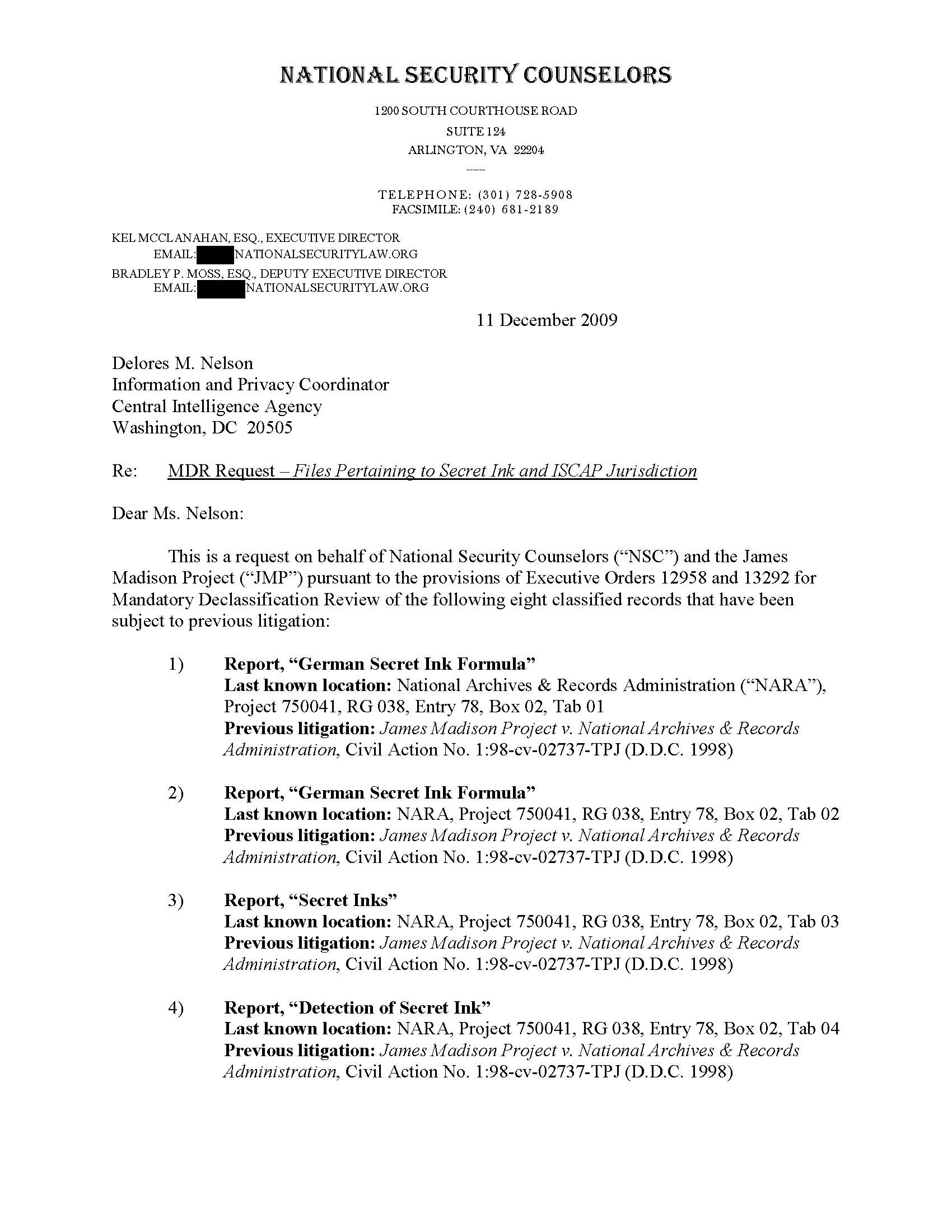
Here is the full MDR request filed by National Security Counselors –that the CIA neglected to mention– that forced the release of these documents. Kel McClanahan, Executive Director of National Security Counselors told Jeff Stein’s SpyTalk that Mark Zaid of the James Madison Project tried to get the documents declassified in the 1990s but was rebuffed by the Agency. In 1998 he even filed an FOIA lawsuit to win the release of the documents.
Undeterred, in 2009 McClanahan and Zaid filed a Mandatory Review Request for the document’s release. The CIA ignored the MDR request for a year. At which point Zaid and McClanahan wisely used their legal right to appeal to ISCAP –the Interagency Security Classification Appeals Panel, which the NS Archive once called the “Secrecy Court of Last Resort.” It’s my guess that ISCAP, which was led by the over-classification conscious Jay Bosanko, informed the CIA they were fighting a losing fight. It was at this point that the Agency decided it would release the docs and take credit, attempting to appear as champions of the public’s right to know, rather than losers of an MDR case.
CIA spokeswoman Marie Harf disagrees. She told Jeff Stein that the release “was not in response to any specific request.” Sure it wasn’t… it’s all just a huge coincidence. We’ll see if the same thing happens with the 50-year-old Bay of Pigs histories that the Archive sued the Agency to release last week.
Despite the CIA’s glory-hounding, the release of the documents is a clear victory for McClanahan, Zaid, intelligence historians, and the Freedom of Information community.
But it also reveals the extreme ineffectiveness of the US Secrecy System. If it takes this extreme fight to release six WW1 era documents explaining that invisible ink is made with lemon juice, don’t hold your breath for the 400 million pages of classified historic US documents stalled at the National Declassification Center.

 UNREDACTED: The National Security Archive Blog
13 responses to “CIA Releases 1917 Invisible Ink Recipe Due to MDR Request, Not Kindness of Heart”
[…] um século até que recentes avanços tecnológicos tornaram possível liberá-los”. Arrã. Revelou porque foi obrigada, isso […]
Herbert Yardley revealed all these methods in 1931 in his book The Black Chamber. The book was in response to Henry Stimson shutting down America’s covert signal intelligence gathering capability. Interestingly enough, there wasn’t a CIA when any of this was printed his book or these documents were produced.
[…] CIA Releases 1917 Invisible Ink Recipe Due to MDR Request, Not … Apr 20, 2011 … The documents –dating from 1917 and 1918– described World War 1 “secret ink” recipes and … […]
[…] edition of the papers and –not wanting to get in trouble– fill in the Mad Lib with the 90-year-old invisible ink recipe the CIA had just declassified. My “secrecy humor” got just a tepid response from the […]
[…] Pigs debacle because it would “confuse the public.” For another, see the CIA’s tooth-and-nail fight against releasing a 95-year-old invisible ink […]
[…] year, the CIA fought tooth and nail to avoid being forced to release the oldest classified documents in the US government. These […]
[…] year, the CIA fought tooth and nail to avoid being forced to release the oldest classified documents in the US government. These […]
[…] this is why the CIA fought tooth and nail against the release of a nearly 100-year-old invisible ink recipe (that was not even an American document and it was already widely available on google scholar); […]
[…] this is why the CIA fought tooth and nail against the release of a nearly 100-year-old invisible ink recipe (that was not even an American document and was already widely available on google scholar); […]
[…] credit: Andrew Gatt, Nate Jones of nsarchive.com, Maria Keays, Whitney of rookie moms, Watch me Play and Learn, Jen of Mrs. Jen’s Kinder […]
I read this post completely concerning the difference of most recent and earlier technologies,
it’s awesome article.
[…] did not want it. It, apparently, was just fine with him to him to keep the Jupiters in Turkey, century-old invisible ink recipes, even Pinochet’s fondness of Pisco Sours, hidden from the public as “national security […]
[…] this is why the CIA fought tooth and nail against the release of a nearly 100-year-old invisible ink recipe (that was not even an American document and was already widely available on google scholar); […]