

The US Department of State announced it will be hosting World Press Freedom Day in 2011.
Julian Assange of wikileaks was denied bail in Great Britain after he was arrested in relation to an interpol warrant for committing “sex by surprise” [Assange’s attorney called it “sex by surprisej.” The interpol warrant was for “one count of unlawful coercion, two counts of sexual molestation and one count of rape,” according to Scotland Yard.] Assange allegedly had consensual sexual intercourse with two women in Sweden, but did not wear a condom. This is apparently a violation of Swedish law. Washingtonsblog sums up the murky details. Salon also has a good rundown.
Meanwhile, the wikileaks site has not stopped releasing documents. It has changed its primary address to wikileaks.ch and has released 1193 of 251,287 (0.47 percent.)
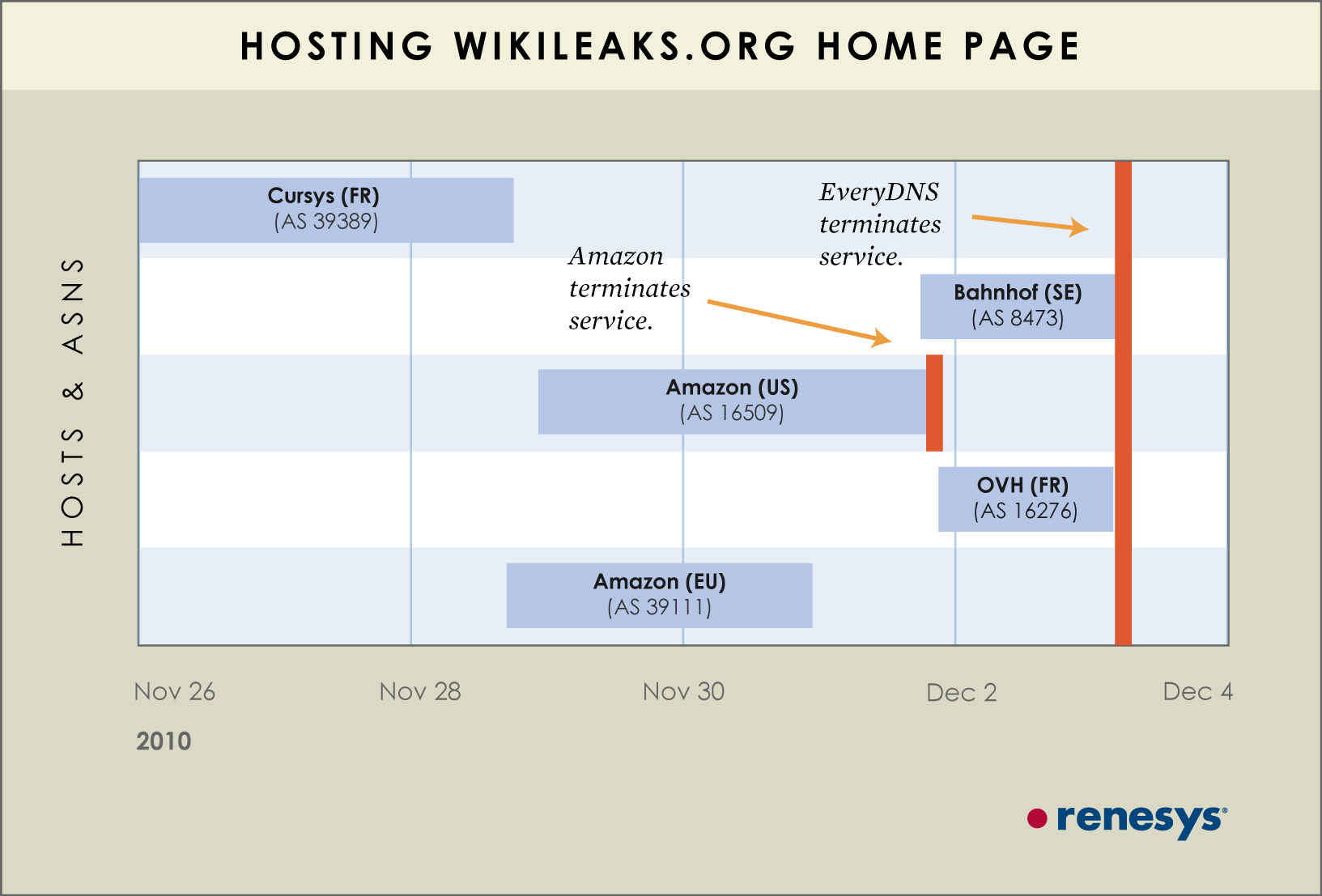
James Cowie at Renesys has a fascinating technical analysis of how and why wikileaks has managed to stay up despite widespread efforts to censor the site, explaining: “The short answer is that the harder you hit them, the bigger they get.”
Paypal, Visa, and Mastercard’s have refused to process donations to wikileaks. After Mastercard began refusing to process wikileaks donations, the denizens of twitter began retweeting, “Freedom of expression is priceless. For everything else, there’s MasterCard.”
Today the websites of Visa, Paypal, and Mastercard (and other sites) were hit with DDoS attacks. (wikileaks has also been the victim of DDoS attacks.)
A wikileaks cable reveals that Visa and Mastercard were beneficiaries of a State Department lobbying effort in Russia.
Senator Dianne Feinstein wrote an op-ed in the Wall Street Journal that wikileaks should be prosecuted under the Espionage Act. To buttress her case, she cited a Congressional Research Service report.
Interestingly, as Steve Aftergood blogs, an updated version of the CRS report states, “There appears to be no statute that generally proscribes the acquisition or publication of diplomatic cables.” (The version Feinstein cited also did not advise that course of action.) Aftergood also tells us:
“Incredibly, CRS was unable to meaningfully analyze for Congress the significance of the newest releases because of a self-defeating security policy that prohibits CRS access to the leaked documents.”
And the Internet Governance Project aptly explains why wikileaks polarizes America’s internet politics.

 UNREDACTED: The National Security Archive Blog
4 responses to “FRINFORMSUM: 12/8/2010”
[…] FRINFORMSUM: 12/8/2010 […]
[…] FRINFORMSUM: 12/8/2010 […]
Wow, this really is great timing. Interesting move. Thanks for sharing!
[…] FRINFORMSUM: 12/8/2010 […]