
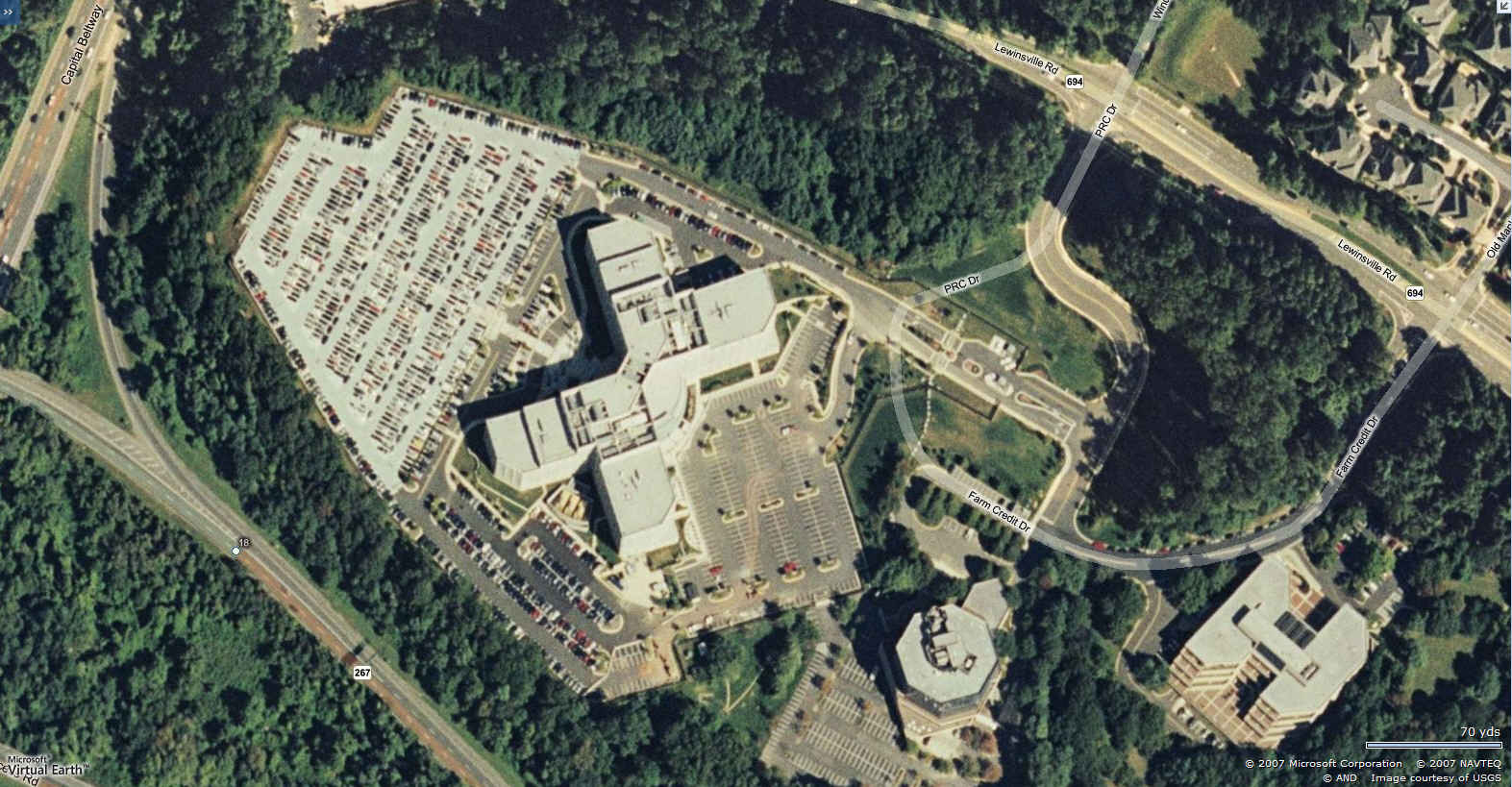
Each day as I walk into work, I see the words cited on the Archive’s 1999 George Polk journalism award and smile. The Archive was recognized for “piercing the self-serving veils of government secrecy, guiding journalists in the search for the truth and informing us all.”
It’s no surprise, then, that I think the Washington Post’s “Top Secret America” project is awesome. The team of “investigative reporters, cartography experts, database reporters, video journalists, researchers, interactive graphic designers, digital designers, graphic designers, and graphics editors” that spent two years tirelessly discovering, compiling, and presenting this data, have succeeded in exposing the ethereal “national security complex” in America.
Perhaps the most apt accolades came from Spencer Ackerman and Noah Schachtman at Wired’s Danger Room, who wrote:
But this piece is about much more than dollars. It’s about what used to be called the Garrison State — the impact on society of a Praetorian class of war-focused elites. Priest and Arkin call it “Top Secret America” and it’s so big, and grown so fast, that it’s replicated the problem of disconnection within the intelligence agencies that facilitated America’s vulnerability to a terrorist attack. With too many analysts and too many capabilities documenting too much, with too few filters in place to sort out the useful stuff or discover hidden connections, the information overload is its own information blackout.
But something continues to nag me about The Post’s project: In an editorial note, The Post states that it originally included additional “data points,” and later eliminated them after “one government body” objected. (“Another agency” objected to the entire website –Fortunately for us, The Post decided not to pull the plug!!)
Which set of “data points” did the Post originally collect and then omit?
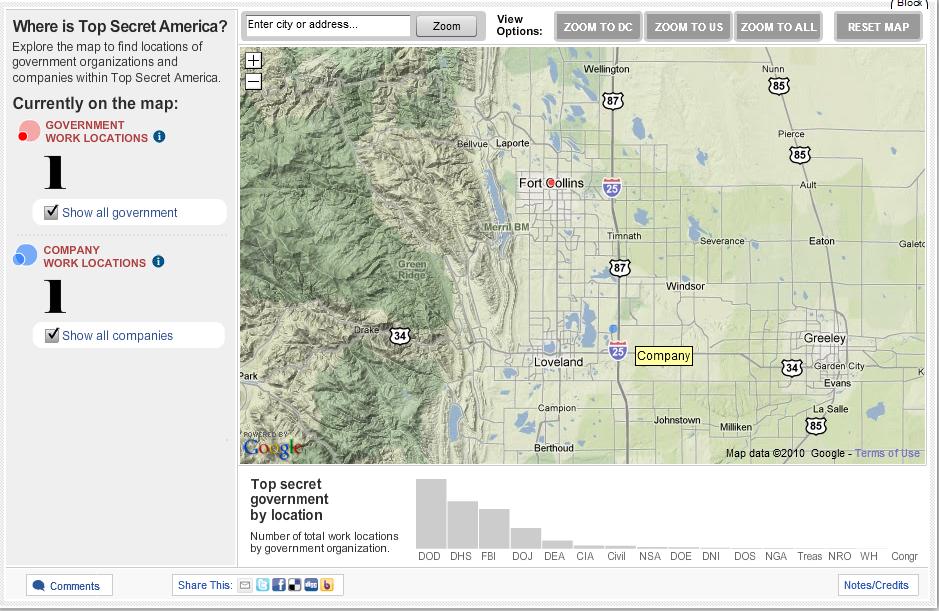
My best, initial guess is that these “data points” were the actual addresses of the locations doing top secret work. Anyone familiar with google maps knows that when you click a dot on a google map, its actual name and address show up. And not surprisingly, any person that uses Top Secret America intuitively clicks on the maps dots and wants to see the names and addresses of what the dots represent. They can’t.
According to The Post, Top Secret America used the Google API (application programming interface). So if they had the tools and data…why did they give their interactive map a counter-intuitive feel?
For example: I saw that top secret work was going on in my home town of Fort Collins, CO. I clicked the “Fort Collins dot.” The map told me that in Fort Collins there were was one “government work location” and one “company work location.” Interesting. As a concerned citizen, I’d like to know what they are. I zoom in further and can see general locations, but not their names. Frustrating.
I try using the database to look up these two locations. I determine the “company work location” is Keypoint Government Solutions. (Its actually based in Loveland, one city over from Fort Collins.) According to The Post, it specializes in “building and personal security.”
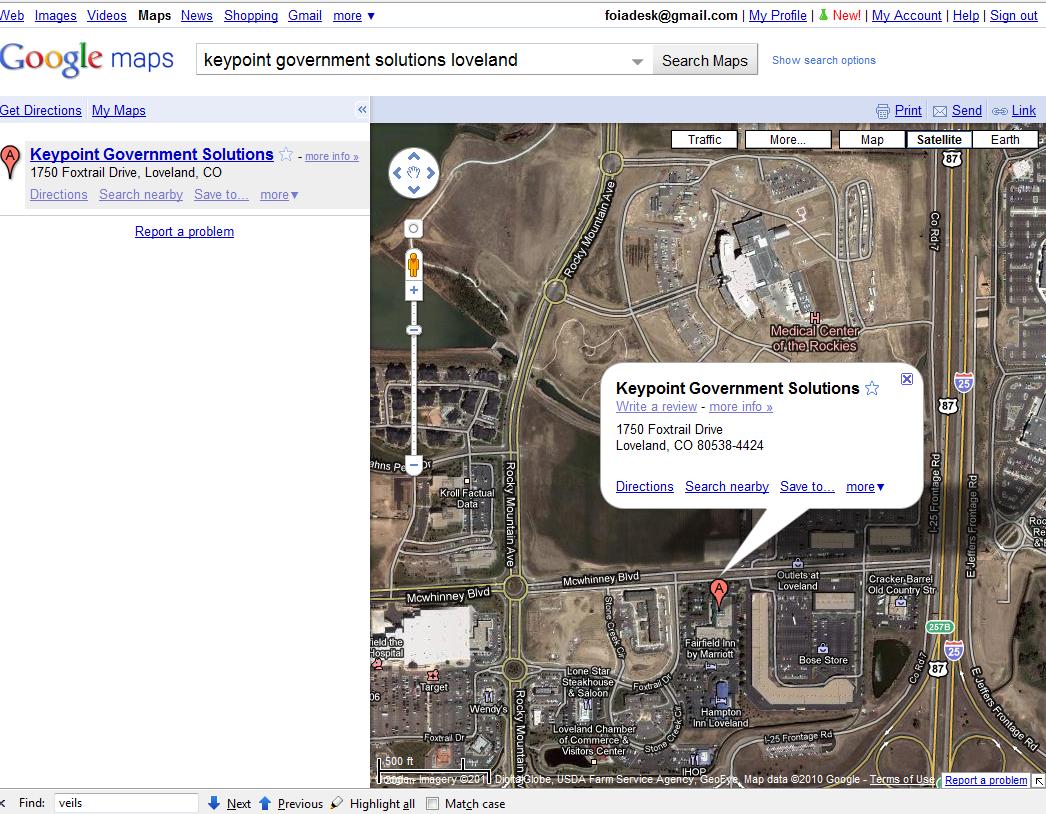
I use google to search “keypoint government solutions loveland” and find the company’s exact address: 1750 Foxtrail Drive, Loveland, CO 80538. Why didn’t the Post include this information on its (otherwise terrific) map? Were they asked not to?
I have still not been able to identify the other “government work location” in Fort Collins. I used the Post’s data search for Colorado and found only one “government organization” (US Northern Command, in Colorado Springs), even though my eye detects 57 governent locations on the map. In the Post’s editorial note, they state that they did this on purpose; Top Secret America lists the location of headquarters, but not regional locations.
This is bizarre because today’s article seemed to (rightfully) relish disclosing these locations. The print edition of The Post shows a bevy of photographs of “government work locations” and the paper names Liberty Crossing, a McLean, VA top secret complex “not on any public map and not announced by any street sign” that “tries hard to hide from view.” It also allerts readers to -among other locations- the clandestine program in Elkridge, MD which “hides in a tall concrete structure fitted with false windows to look like a normal office building.”
So why won’t the interactive site tell us what agency has a “government work” location in Fort Collins (or anywhere else for that matter)? Especially if -as The Post claims– this information is “substantiated by at least two public records.” The Post wrote that it used “public safety judgments” to reach its decisions. I would like to see a fuller explanation of how these decisions were made.
All in all, my intent is not to blast The Post, or to argue for the disclosure of information that would genuinely harm national security, but rather to simply ask: which “certain data points” did The Post go to the trouble of obtaining and then choose not to release? Why did it do this? And was it the right decision?
Quis custodiet ipsos custodes? In this case the Post. At least better than anyone else.
Interested in your comments.

 UNREDACTED: The National Security Archive Blog
6 responses to “What were the “certain data points” which The Post eliminated from “Top Secret America?””
Good post in the same vein by Shane Harris at the washingtonian.
http://www.washingtonian.com/blogarticles/16315.html?msg=99
Clarifying some myths:
Click to access Truth_About_Contractors.pdf
Click to access Question_and_Answer_IC.pdf
Could the National Security Archives conduct an interview with some of the Post reporters who worked on this project in order to address the questions you’ve raised?
[…] databasen tidigare enligt vad Washington Post själva uppger en Google API-koppling. Då är det konstigt att man inte utnyttjade denna koppling fullt […]
[…] database could be classified and withheld from the public, under the mosaic theory.” • The National Security Archives: “Something continues to nag me about The Post’s project: In an editorial note, The […]
[…] “very concerned about security implications” after the Post revealed the (not-so-specific) locations of companies contracting with the intelligence […]