

While in South Africa to watch the World Cup, US Vice President Joe Biden extolled that football had the “power to bring communities and nations together.” It also contributed to a four-day war fought between El Salvador and Honduras in 1969. Declassified Central Intelligence Bulletins provide a pretty exciting day-by-day account of what is now know as “The Football War.”
On 8 June 1969, the Honduran national soccer team defeated El Salvador 1-0 at home in a World Cup qualifying match. A week later, Honduras traveled to El Salvador and lost 3-0. Nationalist sentiment was flaring in both countries. Finally, on June 26, the two teams played a playoff match in Mexico City. In overtime, El Salvador defeated Honduras 3-2 and eventually advanced to the 1970 World Cup. On the same day as the playoff , El Salvador broke diplomatic relations with Honduras.
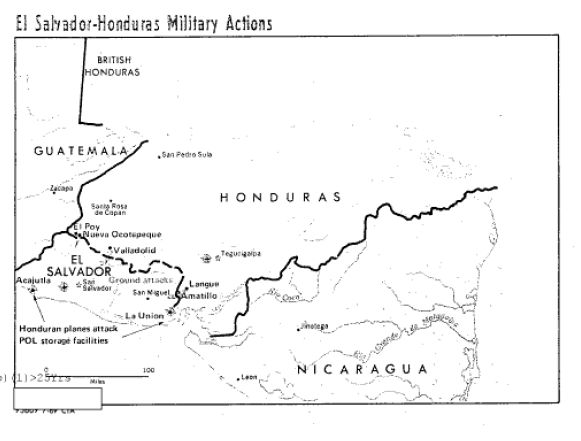
The football rivalry coincided with a political dispute over immigration between the two countries. Essentially, El Salvador was a smaller country than Honduras and had a much larger population. The border between the two nations was less-than-perfectly defined, and an estimated 300,000 Salvadorians immigrated onto the more spacious Honduran territory, causing some resentment from native Hondurans.
After losing the first football match, El Salvadorian nationalist fervor erupted. The fans were so riled that when the Honduran team came to El Salvador to play the second match, the Salvadorian Security Service had to hide the Honduran team at an undisclosed location. As Honduran fans traveled home after losing the match, some Salvadorians threw rocks at their cars.
Due in large part to exaggerated media reports, unorganized mobs in Honduras retaliated against the Salvadorian immigrants living on Honduran territory. Salvadorian business were destroyed, refugees fled, people were killed. The Salvadorian government accused Honduras of genocide. After intermittent border clashes, the military of El Salvador invaded Honduras on 14 July. According to a CIA report, “a nationwide Honduran radio network…exhorted civilians in the western highway area to grab machetes or other weapons and move to the front to assist the army.” This was a nasty –albeit brief– war. The CIA cited more than 1,500 Hondurans deaths during the war, it did not estimate the number of Salvadorians killed.
Despite the civilians with machetes, the Salvadorian Army out-preformed the forces of Honduras. It crossed the border into to Honduran territory and was able to capture and hold nine cities. Some even boasted that teeny El Salvador was now the “Israel of Latin America.” But, according to the analysis of Jay Mallin of Air University Review, Honduran air power trumped El Salvador’s. Honduras’s ability to bomb Salvadorian positions and energy supplies brought the conflict to a stalemate. (Incidentally, Air enthusiasts cite the Football War as the last war in which propeller aircraft fought each other.)
Finally, the Organization of American States (and the US government) brought heavy pressure on both sides to reach a cease fire, which went into effect on 18 July. After much foot-dragging, El Salvador eventually removed its troops from Honduran territory. In 1980, the two countries signed a peace treaty and now maintain friendly diplomatic and trade relations. (I watched a competitive and non-violent “friendly” football game between the two teams at RFK stadium not long ago.)
The Football War is yet another example of the dangers of nationalism. It is also an example of international competition inflaming –not improving– political conflict. And be honest, after writing this, I’m quite relieved that North Korea and South Korea won’t be matched up in the World Cup final.
Note: Yes, I did refer to the sport as “football” throughout this blog post. If America wins the World Cup, I’ll go back through the post and change all references to “soccer.”

 UNREDACTED: The National Security Archive Blog
8 responses to “Document Friday: The Football War”
Soccer hooliganism and rioting marched the final decline of Yugoslavia. Many of the rioters were recruited into the militias responsible for genocide and ethnic cleansing. Unfortunately, CIA records do not provide a good accounting of that time period because even acknowledging their existence will compromise American national security and allow Bin Laden and the legion of doom to take over.
A popular english football chant when they (can’t bring myself to say ‘we’) are playing Germany is”Two world wars and one world cup!”.
Although I’m pretty sure that only the english still remember the ’66 world cup.
How say that there would by educated individuals who still believe that the Hondura/El Salvador war of 1969 was about soccer. Plese for your own sake, do a little research before publishing something like this. This war was as much about soccer as our second Iraq war was about wapons of mass destruction.
Thanks, I think the blog post bears this out…
“The football rivalry coincided with a
political dispute over immigration
between the two countries.”
[…] war may have been short, but no less deadly. Read all about it here, and you will understand the significance. This was not just some Central American nations throwing […]
Hi, I am a journalist in Sweden who writes about the football war. I wonder if it´s possible to use the picture you have in the article (the forst one, from the football field) ? I can pay for it, if necessary. I need an answer before noon today Swedish time…
I believe it’s fair use.
It is amazing to hear historians claiming that this war was due to a soccer match. Shows how ignorant some people can become. Conflict was due to a territorial dispute that happened to be at same time as the game. El Salvador won the battle but Honduras kept the territory in dispute.