
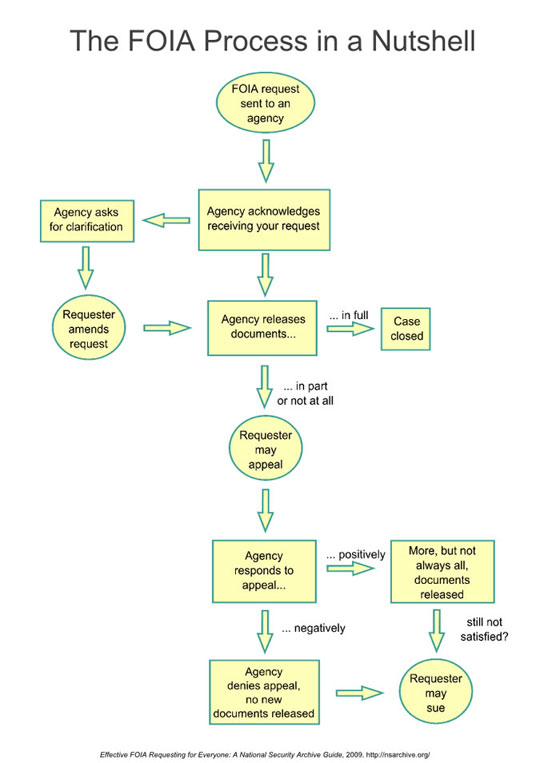
So what happens after you craft that great FOIA letter requesting those docs that will make your article/dissertation/book/life sooo much more interesting? That’s what we’ll be looking at today, the FOIA Process. Follow along with the lovely chart on the right.
- Send the letter. Do your background research, chose the correct agency, and craft a clear and targeted request.
- Receive a response. Generally, you will receive a letter from the agency you sent your request to before twenty business days have expired. Usually, the agency will cite a backlog of requests and tell you that processing your request will take a substantial amount of time. You will usually receive a case number that the agency will use to keep track of your request.
- (Possibly) The agency will ask for clarification. If the agency does not understand your request—or if it is too broad or too narrow—the agency may contact you and ask you to amend your request.
- Once the agency has a clear request, it will begin searching for relevant documents. Federal agencies are big; they have many components and offices, so seeking out the documents you have requested from the billions of pages the agencies hold can be a labor intensive process.
- If the documents contain classified information, FOIA law states that an appropriate agency official must review each record line by line to determine if the information can be declassified or must be withheld. If the document in question contains information from other agencies, the other agencies must also review it for declassification. This can take a long time.
- You’ll get a determination letter. The agency will probably either:
- Release the documents in full.
- Release the documents in part (redacted).
- Release some of the documents in full or in part.
- Issue a “Glomar” response, refusing either to confirm or deny the existence of the records. (More on that in a future post.)
- Or reject the request for a procedural reason—usually correctable.
- Decide if you want to appeal. Anytime an agency withholds information (or says it cannot find documents when you believe it holds them), you have the right to appeal. Craft a strong appeal letter (more on that later) and send it to the agency. Generally, appeals are reviewed by a different, more senior official than the one who made the original determination. Often, they exercise greater discretion in declassifying documents.
- If you are unsatisfied with agency’s determination of your appeal, you have the right to sue for the release of the documents in federal court—a whole other can of worms.
So there you have it, a brief road map of the FOIA Process. Its not the simplest process; but hey, at least it’s not as difficult as a bill becoming a law or an explanation of COIN dynamics.

 UNREDACTED: The National Security Archive Blog
3 responses to “FOIA Tip No. 6—The FOIA Process in a Nutshell”
[…] of the happiest moments a FIOA requester has is when he (or she) wins a FOIA appeal and gets to see what exactly the government was trying to […]
[…] documents are not released or released only in part, you may then appeal, and if necessary, subsequently litigate. The diagram at right offers a quick, visual run-through of the process. You can also follow this supplementary step-by-step guide. […]
[…] Glomar Response is different than a regular FOIA denial—when an agency states that it has the records but that it will not release them. When an agency […]